
Are BMWs reliable? What used car buyers need to know
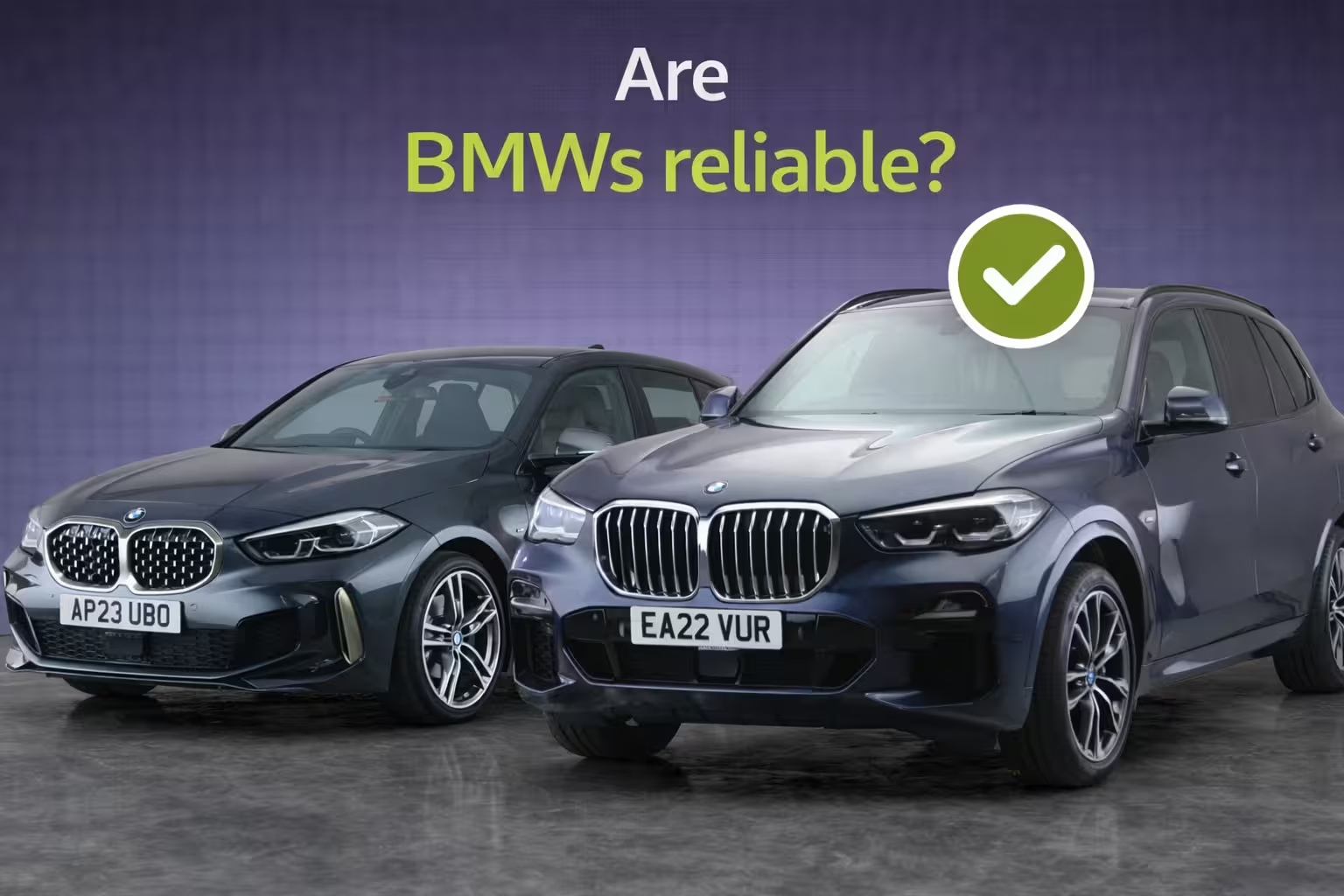
BMW makes some of the most rewarding used cars available in the UK. The driving dynamics, interior quality, and engineering depth of a well-specified BMW represent genuine value at used prices that often sit well below original list. But “are BMWs reliable?” is a question worth answering carefully, because the answer varies significantly depending on which model, which engine, which generation, and — most importantly — how conscientiously the car was serviced during its previous ownership.
This guide gives an honest, model-by-model reliability assessment across the most common used BMWs, covers the specific faults and failure patterns worth knowing about, and explains why servicing costs matter more for premium brands than for mainstream alternatives.
The honest starting point: how BMW reliability compares to the mainstream
In owner satisfaction surveys and reliability data over the past decade, BMW sits broadly in the middle of the premium brand pack — better than many would assume, but behind Toyota, Lexus, and Honda in long-term reliability rankings. The key distinction is that BMWs are more mechanically complex than mainstream cars, and the consequences of deferred maintenance are more expensive. A Toyota Yaris that misses an oil service by 2,000 miles will probably be fine. A BMW 3 Series with the same neglect is more likely to develop a timing chain issue, a water pump problem, or a turbocharger fault.
This is not a criticism of BMW’s engineering quality — it reflects the nature of high-performance, technology-rich powertrains. They are designed to deliver a particular driving experience, and that design carries more complexity than a simple economy engine. The practical implication for used buyers is clear: full BMW main dealer or approved specialist service history matters more on a used BMW than service history on a used Toyota, because the cost of problems that arise from neglect is proportionally higher.
BMW 1 Series (F40, 2019–23) — the entry-level that drives like a driver’s car
The F40-generation 1 Series is the current used-market 1 Series and a genuinely accomplished car. The controversial switch to front-wheel drive (from the previous F20’s rear-wheel drive) was broadly the right engineering decision for the model: better rear headroom, more accessible pricing, and a chassis that still handles better than most front-driven hatchbacks.
The 1.5-litre three-cylinder B38 engine (118i, 136hp) is the volume choice and broadly reliable, though the three-cylinder’s inherent vibration at idle is a characteristic rather than a fault. The 2.0-litre four-cylinder B48 (120i, M135i) is notably more refined at higher speeds. The 2.0-litre B47 diesel (116d, 118d) suits higher mileage with consistent real-world economy of 48–58mpg.
The F40’s main documented issue is the 7-speed DCT (dual-clutch automatic) gearbox fitted to most automatic variants. Low-speed hesitancy and shudder in urban traffic is a characteristic of some examples — test specifically in slow traffic before purchase. The 2022 facelift brought iDrive 8, significantly better software, and physical shortcut buttons; 2022–23 examples are considerably more polished than early 2019–21 cars. Full service history from a BMW dealer or approved specialist is important, particularly for DCT fluid service history.
F40 1 Series reliability summary: Broadly good when correctly serviced. DCT behaviour in slow traffic is the main thing to assess on a test drive. Prioritise 2022–23 examples. Oil specification matters — BMW LL-04 required. Insurance groups are moderate (22–32).
BMW 3 Series (G20, 2019–23) — the benchmark used premium saloon
The seventh-generation 3 Series (G20) is the benchmark used premium saloon in the UK and arguably the car that delivers the best combination of driving engagement, interior quality, and ownership costs in the premium segment at this price. The ZF 8-speed torque converter automatic is one of the best gearboxes available in any car at this price — smooth, fast, and reliable when the ZF oil is changed at the recommended 80,000-mile interval.
The 2.0-litre B48 petrol (320i, 330i) is the most balanced engine: refined, 40–48mpg real-world, and with a strong reliability record on correct service history. The 2.0-litre B47 diesel (320d) is the high-mileage choice, returning 46–58mpg consistently. The 330e PHEV (B46 1.4 TSI, 12kWh, ~36 miles EV range) is increasingly sought-after for company car BIK efficiency; check charging history on any PHEV example.
The G20’s known reliability concerns centre on the B48 engine’s tendency toward oil consumption on higher-mileage examples — check the oil level on purchase and ask about top-up frequency. The electric water pump is a documented failure item across multiple BMW models from this era; replacement costs £300–£600 at an independent specialist. Timing chain stretch on higher-mileage examples (above 80,000 miles) is possible on B47 diesel variants if oil change intervals have been extended — a cold-start rattle is the symptom.
The G20’s adaptive M suspension (standard on M Sport with the optional upgrade) transforms the ride quality on UK roads and is worth specifically seeking out. Without adaptive dampers, the M Sport’s firmer spring and damper rates can be uncomfortable on poor road surfaces.
G20 3 Series reliability summary: Good when maintained correctly. Electric water pump is the main proactive replacement to budget for. Full BMW service history essential. Check oil level and consumption history. Adaptive suspension worth seeking on M Sport. Insurance groups are moderate-to-high (29–38).
BMW 5 Series (G30, 2017–23) — the executive saloon for long-distance drivers
The G30 5 Series is the used car for buyers who regularly cover significant motorway mileage and want a refined, comfortable, highly capable long-distance car at a price that represents genuine value against its original £45,000–60,000 list price. The 3.0-litre straight-six engines (530d, 530i, 540i) are the highlight of the range — exceptionally smooth, well-proven, and the powertrain that genuinely justifies choosing a BMW over a mainstream equivalent.
The 2.0-litre four-cylinder variants (520i, 520d) are the volume choices and represent the most accessible used entry points. The 520d’s B47 diesel (190hp) returns 48–58mpg in real-world motorway use and is one of the more economical large saloons at this price. The 530e PHEV (B46, ~35 miles EV range) suits company car drivers with home charging.
The G30’s reliability concerns are broadly similar to the G20, amplified by the additional complexity of a larger car. The electric water pump is the most commonly cited repair item across all B47/B48 variants. The timing chain on B47 diesels requires attention on high-mileage examples. The air suspension (optional on M Sport, standard on Luxury and Executive) is more complex and expensive to maintain than standard steel spring suspension; if fitted, check for any ride height irregularity or warning lights. Oil consumption on B48 engines is more noticeable on the 5 Series due to the longer service intervals that owners sometimes attempt. Full BMW main dealer service history is important; a 5 Series with independent-only history should be priced accordingly.
G30 5 Series reliability summary: Excellent motoring when correctly maintained. Electric water pump and oil consumption are the main proactive checks. Air suspension cars: check ride height and warning lights. Full BMW main dealer or approved specialist history expected. Insurance groups are higher (30–40).
BMW X3 (G01, 2018–23) — the premium compact SUV
The G01 X3 is one of the most sought-after used premium compact SUVs and represents strong value against its original £40,000–50,000 list price. The xDrive (standard on most UK examples) 4WD system is well-proven and has an excellent reliability record. The 2.0-litre B47 diesel (20d, 190hp or 190hp xDrive) is the volume choice: 46–55mpg real-world, composed motorway refinement, and the ZF 8-speed automatic’s smooth operation. The 3.0-litre M40d (340hp) is the performance diesel variant.
The X3’s reliability picture is broadly the same as the G20 and G30: correct oil specification, timely oil changes, and electric water pump awareness are the main considerations. The xDrive transfer case and front differential on higher-mileage examples benefit from fluid changes that are sometimes missed. The 2021 LCI (Life Cycle Impulse) facelift introduced better infotainment (iDrive 7) and is the generation to prioritise for technology. Full service history is important; 4WD service history should be verifiable.
G01 X3 reliability summary: Good used buy when correctly maintained. Transfer case fluid service on xDrive examples is important at higher mileage. Full BMW history expected. Insurance groups are moderate-to-high (27–36).
BMW X5 (G05, 2018–23) — the premium large SUV
The G05 X5 is a genuinely impressive used car at a price that has fallen significantly from its original £60,000–80,000+ list. The 3.0-litre straight-six mild hybrid diesel (30d, 286hp) is outstanding — smooth, refined, 38–48mpg real-world in a car of this size, and with the kind of motorway performance and refinement that makes genuinely long trips effortless. The xDrive 4WD, air suspension, and the X5’s commanding driving position make it a distinctly capable car for families who regularly carry large loads or tow.
The X5’s ownership costs are higher than anything else on this list, and that is worth being explicit about before purchase. Tyres on the standard 20-inch or optional 21/22-inch alloys are expensive and wear relatively quickly. Air suspension replacement is a significant cost item if it fails. Service costs at BMW main dealers are higher than for a mainstream SUV of equivalent age. The complexity of the X5’s electronics, ADAS systems, and powertrain management means that independent specialist knowledge (a BMW-specific garage rather than a general independent) is important for any out-of-warranty servicing.
The 48V mild hybrid system on the B57 diesel (from 2021) is broadly reliable. The plug-in hybrid X5 45e (3.0-litre straight-six, 30kWh battery, ~50 miles EV range) is increasingly available used; verify charging history and PHEV battery health via a BMW dealer diagnostic on any 45e.
G05 X5 reliability summary: Excellent when correctly maintained but genuinely expensive to run. Tyres, air suspension, and servicing costs must all be factored in. Full BMW main dealer history essential. 45e PHEV: verify battery health. Insurance groups are higher (35–45).
The most common BMW faults across all models
Several fault patterns recur across multiple BMW models and generations and are worth knowing as a used buyer regardless of which specific model you’re considering.
Electric water pump (EWP) failure is the most frequently cited BMW repair across B47 diesel and B48 petrol engines. The plastic-bodied electric pump circulates coolant and can fail without warning, causing overheating. Replacement is £300–£600 at a BMW specialist and is regarded by many independents as a proactive maintenance item on any BMW past 60,000 miles. Ask whether the EWP has been replaced on any BMW you’re considering. If it hasn’t, budget accordingly.
Oil consumption on B48 petrol engines is a documented issue on higher-mileage examples, particularly where extended service intervals have been used. BMW engines should be checked between services; owners who monitor and top up oil regularly experience significantly fewer issues. Check the oil level on any BMW before purchase and ask specifically about top-up history. A car that is “always” topped up between services is telling you something about its consumption rate.
Timing chain stretch on B47 diesel engines affects higher-mileage examples where oil change intervals have been extended or incorrect oil used. Cold-start rattling that settles after a few seconds is the primary symptom. On a car with above 80,000 miles and any service gaps, a timing chain inspection is advisable before purchase.
Injector and high-pressure fuel pump issues on diesel variants are manageable with correct servicing but can be expensive (£400–£1,200 per injector) when they fail. Diesel engines that have been used primarily for short urban journeys are at higher risk from incomplete combustion deposits.
Air suspension failure on models equipped with it (X5, some 5 Series, some 7 Series) is the most expensive single repair item on any BMW at this age. Replacement compressors, air struts, and control blocks can collectively cost £2,000–5,000 at a specialist. Check for uneven ride height, slow levelling, or warning lights on any air-equipped BMW.
Icom/OBD coding and software issues are more common on BMWs than on mainstream cars due to the complexity of the F-CAN system. Non-standard software modifications, aftermarket coding, or previous track-day mode configurations can cause persistent warning lights or unexpected behaviour. A VCDS or BMW ISTA scan before purchase is worthwhile on any high-performance variant.
Servicing costs: why they matter more for premium brands
The cost of servicing and repairing a premium brand car does not depreciate at the same rate as the car itself. A 2019 BMW 3 Series at £18,000 costs roughly the same to service and repair as it did at £38,000. This proportional difference — a £500 repair representing 1.3% of original value vs 2.8% of current value — is the single most important financial reality of used premium car ownership.
The practical implication: a used BMW with full main dealer or approved specialist service history is genuinely worth more than one without it, and that premium is worth paying. The alternative is either paying more for repairs when things go wrong, or being unable to verify what has and hasn’t been maintained.
Independent BMW specialists — garages that work specifically or primarily on BMW and MINI — are typically 30–50% cheaper than main dealers for routine servicing while maintaining equivalent technical knowledge of the brand. Using a good independent BMW specialist from the point of purchase is a sensible strategy for managing ongoing running costs.
For the most peace of mind, any used BMW with significant remaining manufacturer warranty — or a fresh dealer-warranty purchase — eliminates much of the individual repair risk during the warranty period. Carsa’s 90-day warranty on every car provides additional coverage from the point of purchase.
Which BMW to buy: honest summary recommendations
The most reliable and lowest-risk used BMW at this price is the 3 Series G20 (2020–23) with the B48 petrol engine, ZF 8-speed auto, full BMW service history, and adaptive M suspension. It delivers the most genuinely rewarding driving experience of any used premium saloon at this price, and the ownership risk is manageable with correct maintenance. Avoid examples with high mileage and unclear oil change history.
For buyers who cover high mileage and want diesel efficiency: the 5 Series G30 520d or 530d with full service history is the choice — one of the most refined long-distance cars at its price point. The running costs are higher than a mainstream alternative, but the driving experience justifies them for the right buyer.
The X5 G05 is the most rewarding used large premium SUV but also the most expensive to run. Only buy one with full main dealer history, at a price that reflects the ownership costs honestly, and with a clear plan for ongoing specialist servicing.
Find a used BMW at Carsa
Carsa regularly stocks a wide range of used BMWs across the 1 Series, 3 Series, 5 Series, and X Series, all priced on average £700 below market value and comprehensively inspected before sale. Every car comes with a 90-day warranty as standard, and finance is available from 8.9% APR (10.9% APR representative).
Related articles




Ready to find your next car?
Browse hundreds of expertly prepared used cars — all fully checked, cleaned, and ready to drive away.
Talk to us, anytime.
Our friendly team is just a message or call away.
Message us on whatsapp, 24/7