
Hybrid car finance: the smart middle ground between petrol and electric
Why hybrid is having its moment
UK hybrid car sales hit record levels in 2025, and the trend is accelerating. With the new car ZEV mandate pushing manufacturers to electrify their ranges, and used hybrid supply growing rapidly as early adopters move on to fully electric vehicles, 2026 is arguably the best year in history to buy a used hybrid. Prices are competitive, the technology is mature and proven, and the running cost advantages over petrol and diesel are substantial.
For buyers who want lower fuel bills and a cleaner footprint without the range anxiety, public charging dependency, or higher purchase price of a fully electric car, hybrid represents a genuinely compelling middle ground. And for finance buyers specifically, hybrids come with some unique considerations that make them worth understanding before you sign an agreement.
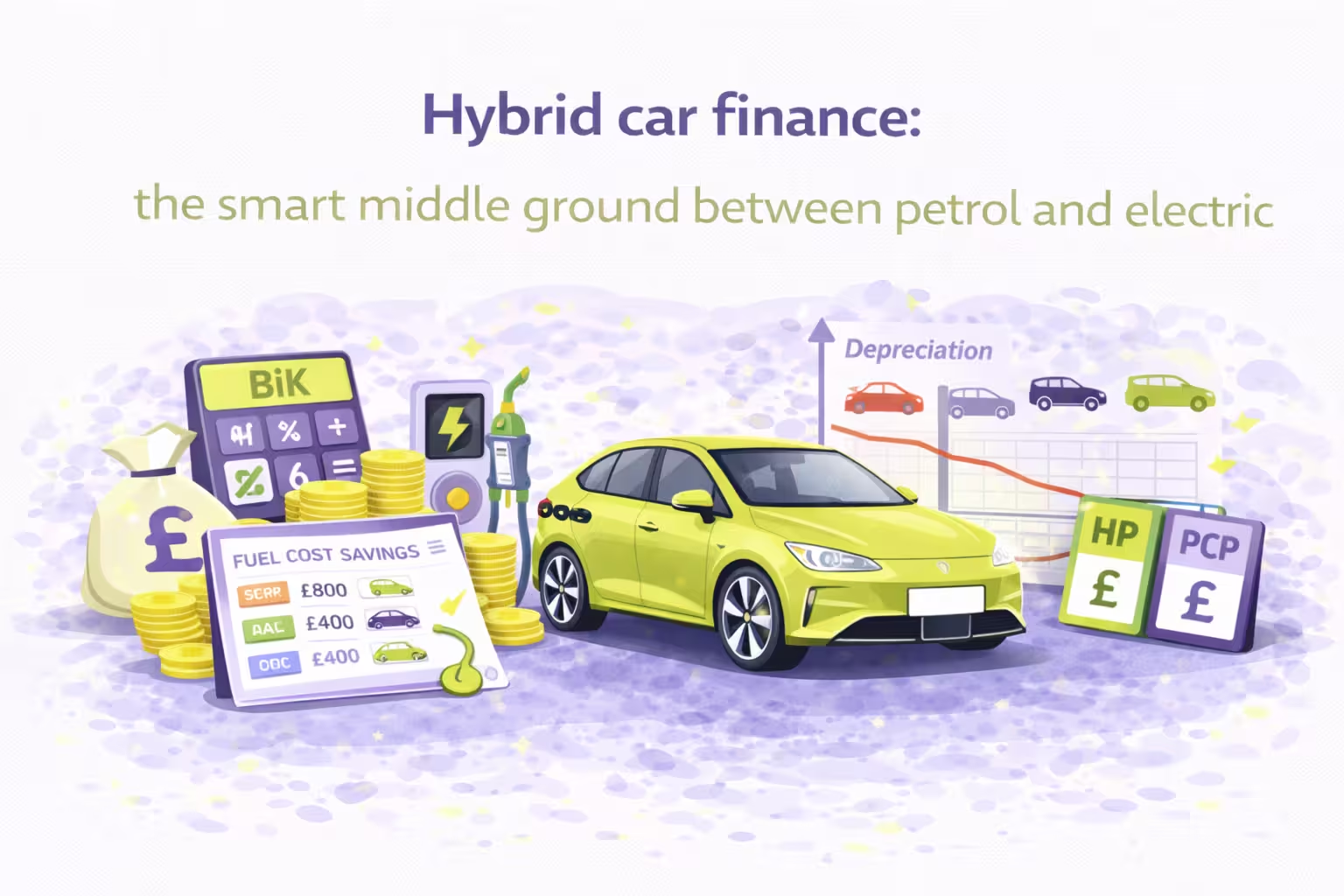
This guide covers everything you need to know about financing a hybrid in 2026 — including how fuel savings affect the real cost of your monthly payment, how hybrid depreciation profiles compare to petrol and diesel, what company car drivers need to know about BiK rates, and whether PCP or HP is the better finance structure for this type of vehicle.
The three types of hybrid — and why it matters for finance
Not all hybrids work the same way, and the type you choose has a significant effect on fuel savings, insurance costs, and ultimately the total cost of ownership that your finance agreement needs to be measured against.
A mild hybrid (MHEV) uses a small electric motor to assist the combustion engine — typically during acceleration and to recover braking energy — but cannot drive on electric power alone. Fuel savings are modest, typically 5–15% over the equivalent petrol or diesel. These are the most common and most affordable hybrid type on the used market.
A full hybrid (HEV) — the type pioneered by the Toyota Prius and now standard across the Toyota and Lexus ranges — can drive short distances on electric power alone and switches seamlessly between electric and petrol. Real-world fuel savings of 25–40% over a comparable petrol car are achievable in everyday driving, particularly in urban conditions. Battery charging is entirely automatic — you never plug in.
A plug-in hybrid (PHEV) has a larger battery that you charge from a wall socket or public charger, enabling 20–50 miles of purely electric driving before the petrol engine takes over. For drivers who charge regularly and have shorter commutes, real-world fuel costs can approach those of a fully electric car. For drivers who don't charge regularly, a PHEV can actually be less efficient than a full hybrid because of the extra battery weight.
For most used car buyers on finance, full hybrids offer the best combination of fuel savings, simplicity, and value. PHEVs make sense if you have regular access to charging and your driving pattern suits the electric range.
MHEV
Mild Hybrid
Electric motor assists — can't drive on electric alone
Fuel saving vs petrol5–15%
Charging required?No
Best finance typeHP or PCP
Entry price on used marketLowest
Best for: Buyers wanting a smooth, modern drive with modest fuel savings and no new habits required.
HEVMost popular
Full Hybrid
Self-charging — drives short distances on electric only
Fuel saving vs petrol25–40%
Charging required?No — self-charging
Best finance typePCP (strong residuals)
Depreciation profileStrong
Best for: Most buyers — genuine fuel savings, no charging infrastructure needed, proven reliability and strong resale values.
PHEV
Plug-in Hybrid
Larger battery — 20–50 miles of pure electric range
Fuel saving vs petrolUp to 80%*
Charging required?Yes — to realise savings
Best finance typeHP (own outright)
Company car BiK5–14% (lowest)
Best for: Company car drivers and those with home charging who have mostly short urban commutes. *If charged regularly.
How fuel savings affect the real cost of your monthly payment
This is the calculation most finance buyers overlook entirely, and it meaningfully changes how hybrid finance stacks up against petrol alternatives.
Monthly finance payments are what buyers compare when shopping around. But the monthly cost of running a car is the finance payment plus fuel, insurance, and servicing. When a hybrid saves you £80–£120 per month in fuel compared to an equivalent petrol car, that saving directly offsets the finance payment — and suddenly a hybrid that looks £30–£40 more expensive per month on finance than a petrol alternative is actually cheaper in total monthly outgoings.
As an example: a used Toyota RAV4 Hybrid financed at £320 per month with an average fuel cost of £120 per month produces a combined running cost of £440 per month. An equivalent petrol SUV financed at £280 per month with average fuel costs of £210 per month produces £490 per month. The hybrid is cheaper to run, even though the finance payment is higher — and that's before accounting for lower servicing costs from reduced brake and engine wear.
When comparing hybrid finance against petrol alternatives, always add fuel costs to your comparison. The monthly payment alone is an incomplete picture.
True monthly cost comparison: hybrid vs petrol
Finance payment + fuel — the number that actually matters
🚗 Petrol car
£
£
🔋 Hybrid car
£
£
Petrol — total monthly
Finance—
Fuel—
—
Hybrid — total monthly
Finance—
Fuel—
—
Hybrid depreciation: what the numbers show
Depreciation — the rate at which a car loses value — is one of the biggest hidden costs of car ownership, and it has a particular relevance to PCP finance where the guaranteed future value (the balloon payment) is based on predicted residual values.
Hybrid depreciation profiles have improved significantly as the technology has matured. In the early years of hybrid adoption, residual values were uncertain and some lenders priced balloon payments conservatively as a result. That picture has changed substantially.
Established full hybrid models — particularly Toyota and Lexus vehicles — now consistently demonstrate strong residual values, often outperforming equivalent petrol models of the same age. The Toyota Yaris Hybrid, RAV4 Hybrid, and Lexus UX are regularly cited among the lowest-depreciating vehicles in their segments. This matters for finance buyers on PCP because higher predicted residual values translate directly into lower monthly payments for the same car at the same APR.
PHEVs carry a more nuanced depreciation picture. Early PHEV models depreciated sharply as range capabilities were modest and the technology less proven. More recent PHEV models from mainstream manufacturers have stabilised, but residuals vary more than full hybrids. HP finance — where depreciation isn't directly factored into the monthly payment structure — is often a more straightforward choice for PHEV buyers who want to own the car outright.
PCP vs HP for hybrid cars
Both finance structures work for hybrid cars, but they suit different buyer priorities.
PCP makes the most sense for full hybrid buyers who are drawn to well-established models with strong and predictable residual values. On a Toyota RAV4 Hybrid or Lexus UX, a lender can set a confident guaranteed future value, which keeps PCP monthly payments competitive. PCP also gives you the option to hand the car back at the end of term — which suits buyers who want to upgrade to a newer hybrid or move to fully electric in three or four years without worrying about what their car is worth.
HP makes more sense for PHEV buyers, buyers who want to own the car outright, or those who drive high annual mileages. On a PCP, exceeding agreed annual mileage reduces the car's residual value and can expose you to end-of-term charges. HP has no mileage restrictions — you own the car at the end, and higher mileage doesn't create a contractual liability.
HP also works well for buyers who plan to keep the car for longer than a standard 36–48 month PCP term. A hybrid's battery and drivetrain longevity is considerably better than its early reputation suggested — modern full hybrid batteries regularly last well beyond 150,000 miles with minimal degradation — making longer-term ownership a genuinely attractive option.
Company car drivers: hybrid BiK rates in 2026
For anyone who receives a company car as part of their employment package, Benefit in Kind (BiK) tax is the figure that determines how much income tax you pay on that benefit. BiK rates are set by HMRC and applied as a percentage of the car's list price, with the percentage varying by CO2 emissions and electric range.
Full hybrid cars attract significantly lower BiK rates than equivalent petrol or diesel models. A full hybrid producing 100–119g/km CO2 attracts a BiK rate of around 25–27% in 2026/27, compared to 34–37% for a petrol car in the same emissions bracket. For a company car driver paying 40% income tax on a £35,000 list price hybrid, that difference can represent savings of £500–£1,000 per year in income tax.
PHEVs attract even lower BiK rates — typically 5–14% depending on their official pure-electric range — making them exceptionally tax-efficient for company car drivers who qualify. A PHEV with a 40-mile electric range at a 8% BiK rate on a £40,000 list price costs a 40% taxpayer approximately £1,280 per year in BiK tax, compared to over £5,000 for an equivalent petrol car. The numbers are compelling for the right driver in the right role.
For private buyers rather than company car drivers, BiK rates are irrelevant — but the same low-emission profile that produces low BiK rates also produces lower Vehicle Excise Duty (road tax) in some bands, which is a smaller but still real ongoing cost saving.
Company car BiK rates 2026/27 — hybrid vs petrol on a £35,000 car (40% taxpayer)
Car type
BiK %
Annual tax (40%)
vs petrol
Petrol car120–139g/km CO2
34–37%
~£4,760–£5,180per year
Baseline
Full hybrid HEV100–119g/km CO2
25–27%
~£3,500–£3,780per year
Save ~£1,400/yr
Plug-in hybrid PHEV30–40 mile electric range
8–12%
~£1,120–£1,680per year
Save ~£3,500/yr
PCP
When PCP works best for hybrids
✓You want a full hybrid (HEV) with strong, predictable residual values
✓You drive a controlled annual mileage (under 12,000–15,000 miles/year)
✓You want the option to upgrade to a newer hybrid or EV in 3–4 years
✓You're buying a Toyota or Lexus hybrid where balloon values are well-established
Why it works: Strong residual values on proven full hybrids keep PCP monthly payments lower than you'd expect.
HP
When HP works best for hybrids
✓You're buying a PHEV and want to own the car outright at the end
✓You drive high mileage — no mileage caps or end-of-term penalties
✓You want to keep the car for 5+ years and benefit from long-term hybrid reliability
✓You prefer straightforward ownership with no balloon payment decision at the end
Why it works: Hybrid batteries regularly exceed 150,000 miles — HP lets you capitalise on that long-term durability.
Browse Carsa's hybrid stock
Find a hybrid that fits your budget — and check your finance rate today
Used hybrids priced on average £700 below market value. Finance from 8.9% APR. Every car with a 90-day warranty. Soft search eligibility check — no credit impact.
✓ Full hybrids & PHEVs in stock
✓ Finance from 8.9% APR
✓ 90-day warranty
✓ £700 below market avg
What to look for when financing a used hybrid
Used hybrids require a few additional checks beyond the standard used car inspection — most of which are straightforward and shouldn't deter buyers.
Battery health is the primary consideration unique to hybrids. Most manufacturers offer battery diagnostics that a dealer can run to confirm the high-voltage battery is within specification. Toyota, for example, provides a full hybrid health check that includes battery capacity data. Ask for this report when viewing any used Toyota or Lexus hybrid. For brands that don't offer a manufacturer-specific check, a specialist hybrid inspection from an independent garage costs around £50–£100 and is money well spent on a higher-value purchase.
Service history matters more on hybrids than on standard combustion cars, not because hybrids are less reliable, but because the regenerative braking and thermal management systems benefit from manufacturer-specified servicing intervals. A full service history from a manufacturer-approved garage is the gold standard. Independent servicing with evidence of manufacturer-recommended parts is acceptable on older models.
Mileage context is different for hybrids. A Toyota RAV4 Hybrid with 90,000 miles and a full service history is a very different proposition to a high-mileage petrol equivalent. The hybrid drivetrain and regenerative braking system means brake components, clutch wear (for appropriate models), and engine stress are all reduced compared to a petrol car covering the same distance. Don't dismiss higher-mileage hybrids on mileage alone.
Financing a hybrid at Carsa
Carsa stocks a broad range of used hybrid vehicles across full hybrid and PHEV types, all priced on average £700 below market value. Finance is available from 8.9% APR representative, with every car covered by a 90-day warranty as standard.
You can check your personal eligibility and see your indicative monthly payment in two minutes — soft search only, no impact on your credit score. Browse Carsa's current hybrid stock with live finance examples to find the model and monthly payment that works for your budget.
Check my eligibility — no credit impact →
Browse hybrid cars with finance examples →
Related reading:
Related articles




Ready to find your next car?
Browse hundreds of expertly prepared used cars — all fully checked, cleaned, and ready to drive away.
Talk to us, anytime.
Our friendly team is just a message or call away.
Message us on whatsapp, 24/7