
What is a V5C? Your complete guide to the logbook
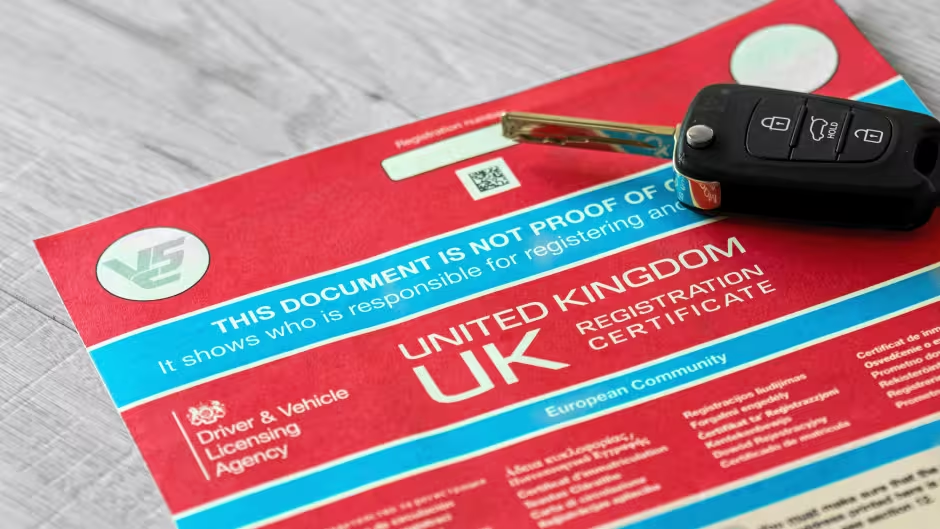
What is a V5C?
The V5C — commonly called the logbook — is the official registration document for a vehicle in the UK. It's issued by the Driver and Vehicle Licensing Agency (DVLA) and records the key details of the car and its registered keeper. Every road-legal vehicle in the UK has one.
It's worth being clear on something that catches buyers out: the V5C is not proof of ownership. It records who the vehicle is registered to — the registered keeper — which is not necessarily the same thing as the legal owner. A car on finance, for example, is legally owned by the finance company while the agreement is active, even though the driver is the registered keeper and holds the V5C. This distinction matters when buying a used car.
What information does the V5C contain?
The V5C is an A4 document, currently printed in a distinctive red-brown colour, containing a comprehensive record of the vehicle. The key sections include the vehicle registration number (number plate), make, model, body type, colour, engine size, fuel type, and VIN (Vehicle Identification Number — the car's unique 17-character identifier). It also records the date of first registration, the registered keeper's name and address, and the date the current keeper acquired the vehicle.
At the back of the document is a section for recording changes of keeper, previous keeper details (in some cases), and a section that can be detached and sent to the DVLA when the car is sold. The document also carries a unique reference number used for DVLA correspondence.
Why does the V5C matter when buying a used car?
The V5C is the starting point for any used car check — not the end of it. When viewing a used car, the logbook tells you the car's registered details: how they compare to the physical car in front of you is the critical question.
The VIN recorded on the V5C should match the VIN plate on the vehicle — typically found on the dashboard (visible through the windscreen), door jamb, or under the bonnet. A mismatch is a serious red flag. It can indicate that the car has been written off and rebuilt using parts from another vehicle, or in the worst case, that the car is stolen and has had its identity changed — a practice known as VIN cloning or car ringing.
The colour recorded on the V5C should match the car. If the car has been resprayed without the V5C being updated, it may indicate accident repair work that hasn't been properly disclosed.
The number of previous keepers is recorded, though in condensed form on recent documents. A high number of previous keepers isn't necessarily a problem — fleet and lease cars change hands frequently and often represent good value — but it warrants a question about why.
The registered keeper's name and address should match the person selling the car. If you're buying from a private seller who can't demonstrate they are the registered keeper, proceed with extreme caution. A car sold by someone who isn't the registered keeper, or sold without the logbook, should prompt an HPI check before any money changes hands.
What doesn't the V5C tell you?
The V5C is a registration record, not a history report. It does not tell you whether the car has outstanding finance against it, whether it has been written off, whether it has been stolen and recovered, whether the mileage has been tampered with, or whether it has been involved in serious accidents. For all of these, you need a paid vehicle history check — the most widely used in the UK are HPI Check, RAC Vehicle History Check, and the AA's equivalent service.
A full vehicle history check is a relatively small cost against the price of a used car purchase and provides protection that the V5C simply cannot.
What to do when you buy a used car: V5C process
When you buy a used car privately, the seller should complete Section 6 of the V5C (the "New Keeper" section) and hand it to you. The seller retains the main document and sends it to the DVLA to notify them of the sale — or uses the DVLA's online service to transfer keeper details. You should then receive a new V5C in your name, issued to your address, within approximately two to four weeks.
If you buy from a dealer, the process is typically handled for you. The dealer notifies the DVLA and you receive a new V5C in due course. Keep the "New Keeper Supplement" (Section 6) as evidence of your ownership in the interim, before the full V5C arrives.
Do not drive away from a private sale without the Section 6 supplement. It is your only interim proof that you are the registered keeper.
What to do if your V5C is wrong
If the details on your V5C are incorrect — a wrong address following a house move, a change of name, or an error in the vehicle details — you can update it online via the DVLA's online service (available at gov.uk) or by completing the relevant section of the physical document and posting it to the DVLA. Most changes of address and personal details can be made online and result in a new V5C being issued free of charge within two to four weeks.
If the vehicle details themselves are wrong — for example, an incorrect colour following a respray, or engine details that don't match following a legitimate engine change — the process involves contacting the DVLA directly and may require supporting documentation.
What to do if your V5C is lost
If your V5C is lost, stolen, or damaged, you can apply for a replacement using form V62, available from Post Offices or the DVLA website. There is a £25 fee for a replacement V5C. You can also apply online via gov.uk if you have the vehicle's registration number and your details are already recorded against it. A replacement is typically issued within five working days.
If your V5C is lost and you're selling the car, you don't legally have to have the logbook to sell — but most buyers will be (rightly) cautious about purchasing a car without one, and it's strongly advisable to obtain a replacement before listing. Selling without a V5C significantly reduces buyer confidence and market value.
The V5C and car finance
One question that comes up regularly for buyers financing a car: who holds the V5C? The answer is that the registered keeper holds the V5C regardless of whether the car is on finance. The logbook will be in the buyer's name and at their address. The finance company's interest in the vehicle is recorded via the HPI register (through the finance company registering the agreement) — not through the V5C itself.
This means that if you run an HPI check on a car and it comes back clear, but the seller cannot produce a V5C, the two issues are separate: the clean HPI confirms no recorded finance, but the missing logbook remains a concern about the vehicle's identity and history.
Buying a used car at Carsa
Every used car at Carsa comes with its V5C documentation in order. Vehicle history is checked as part of our preparation process, and full documentation is available for every car in our stock. Browse our current range with finance examples online, or visit any of our stores.
Check your finance eligibility — no credit impact →
Related reading:
Related articles




Ready to find your next car?
Browse hundreds of expertly prepared used cars — all fully checked, cleaned, and ready to drive away.
Talk to us, anytime.
Our friendly team is just a message or call away.
Message us on whatsapp, 24/7