
What is Isofix and Does My Car Have It?
If you're buying a used car for a growing family, or you've recently had a child and are wondering about car seat safety, Isofix is one of the most important things to understand. It's the safest way to attach a child seat in a car — and in 2026, it's fitted to virtually every car sold in the UK in the past decade. Here's a complete guide to what Isofix is, how it works, and how to know whether your car has it.
What is Isofix?
Isofix is a standardised system for attaching child safety seats directly to a car's structure. Rather than securing a child seat with a seat belt, an Isofix-compatible seat uses rigid metal connectors that clip into dedicated anchor points built into the car's body. The connection is firm, secure, and doesn't rely on the seat belt being routed correctly.
The name comes from ISO Fix — the International Standards Organisation's specification for the system, which was developed in the late 1990s and began appearing on mainstream cars in the early 2000s. Isofix has been mandatory on all new cars sold in Europe since 2014, so any car manufactured from around 2013 onwards is very likely to have it fitted. On cars built between 2003 and 2013, many models have Isofix fitted as standard or as an option; for older cars, it's worth checking before assuming it's there.
Why is Isofix safer than a seatbelt?
Fitting a child seat with a seatbelt isn't inherently unsafe — but it relies on the belt being routed through the correct channels, tensioned properly, and not twisted. Research suggests that a significant proportion of belt-fitted child seats are incorrectly installed. Isofix removes most of that uncertainty because the seat connects directly to the car's structure in a single motion, with an audible click to confirm correct installation.
Because the Isofix connection is rigid rather than relying on belt tension, there's also less movement of the seat in a collision. This matters because even a seat that's correctly belt-fitted can shift during impact in ways that an Isofix seat won't.
For parents who regularly move a seat between cars — a grandparent's car, a partner's car — Isofix is particularly useful because the installation is consistent and quick rather than having to re-route and re-tension a belt each time.
How do I know if my car has Isofix?
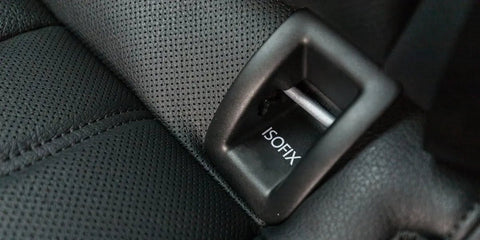
The most reliable way is to look for the labels. Isofix mounting points are marked with a small tag or button on the rear seat backs — usually a small fabric tag with either the word 'Isofix' or a diagram of a child in a seat. The actual mounting points are metal loops or brackets built into the gap where the seat cushion meets the seat back, typically covered by the fabric and revealed by pushing the fabric aside or lifting a small plastic flap.
You'll also find Isofix listed in the car's handbook under safety features, or in the specifications on any used car listing. At Carsa, full specification details are listed on every vehicle, so you can check whether a car includes Isofix before visiting.
If you're unsure, a quick search for your car's make, model, and year alongside 'Isofix' will usually confirm it. The manufacturer's website and most used car databases will tell you whether it was standard or optional on your specific variant.
Where are the Isofix points in the car?
On most cars, Isofix points are fitted to the outer two rear seats — the left and right positions behind the driver and front passenger. The middle rear seat sometimes has a third Isofix point, but not always. Cars with a third central Isofix point are worth knowing about if you regularly need to carry three children in a row — see our guide to used cars with three Isofix points for specific model recommendations.
Some cars also have an Isofix point on the front passenger seat — useful for fitting a rear-facing infant seat up front, though this should only be done with the passenger airbag deactivated.
What types of Isofix child seats are there?
Not all Isofix seats are the same, and the type you need depends on your child's age, weight, and height. Child seats in the UK are categorised using both weight groups (older system) and size groups (i-Size, the newer standard).
Infant carriers / Group 0+ (birth to approx. 12–15 months). These rear-facing seats often use a separate Isofix base that stays in the car while the carrier clicks in and out. The base attaches via Isofix connectors, and many also have a support leg that braces against the car floor for additional stability. Check that the support leg is compatible with your car's floor — it can't be used if there's an underfloor storage compartment in the way.
Group 1 seats (approx. 9 months to 4 years). Forward or rear-facing toddler seats that attach directly via Isofix connectors. Many use a top tether — a strap that connects to an anchor point behind the seat back, usually built into the parcel shelf area — for additional security. Check your handbook to locate the top tether anchor.
Group 2/3 seats (approx. 4 to 12 years). Booster seats for older children. These use the Isofix connection points in a slightly different way (sometimes called Isofit rather than Isofix) to keep the seat in position while the child uses the car's own seatbelt. The Isofix connection stabilises the seat position rather than fully securing it as on a younger child's seat.
i-Size (R129) seats. The newer European standard, introduced from 2013, applies stricter testing criteria and extends rear-facing requirements to at least 15 months. All i-Size seats use Isofix. Many new child seats are now sold to the i-Size standard, and it's compatible with the same Isofix anchor points — so if your car has Isofix, it will accept i-Size seats.
When did Isofix become mandatory?
Isofix has been a legal requirement on all new cars sold in the EU (and the UK, which adopted the same standard) since November 2014, under UN Regulation 44. This means any car that was new from late 2014 onwards will have at least two Isofix points in the rear. Cars manufactured before that date may or may not have it fitted depending on make, model, and specification.
In practice, many mainstream manufacturers began fitting Isofix as standard well before the 2014 deadline. Most cars from 2010 onwards have it on mid and upper trim levels; many cars from 2006 onwards have it fitted. The safest assumption is to check your specific car rather than rely on the year alone.
Are all child seats compatible with Isofix?
Not all child seats are Isofix-compatible. Some are designed to be belt-fitted only, which is fine — it's a valid and tested method when done correctly. If you regularly transfer a seat between a car with Isofix and one without, a belt-fitted seat gives you flexibility. Many parents buying a used car specifically check for Isofix compatibility precisely so they don't have to deal with this.
When buying a child seat, always check that it's approved for use in your specific car. Child seat manufacturers publish compatibility guides on their websites, and most retailers will allow you to test a seat in your car before purchasing. If in doubt, an independent child seat fitting service — offered by many retailers and some fire stations — can check and fit the seat correctly.
Isofix and buying a used car: what to check
If Isofix is important to your family, it's worth making it part of your used car checklist rather than assuming it's present. When viewing a used car at Carsa or anywhere else, check that the Isofix labels are visible and the metal anchor points are intact and undamaged. Occasionally the fabric cover over the Isofix slot can become detached or damaged — easy to fix, but worth noting. Check that both outer rear seat points are present, and verify the middle seat if you need three.
If you're buying a car with a front passenger Isofix point, confirm that the passenger airbag can be disabled — this is essential if you want to use a rear-facing seat in the front. The deactivation switch is usually in the glovebox or dashboard area; check the handbook for your specific car.
At Carsa, full specification details are listed on every vehicle in our stock, including safety features. All our used cars go through a comprehensive inspection before sale and come with a 90-day warranty as standard.
Find a family-friendly used car at Carsa
Looking for a used car with Isofix, three rear mounting points, or specific family-friendly features? Browse our current stock, filter by your requirements, and check your finance eligibility in minutes — no effect on your credit score.
Browse used family cars at Carsa →
Related articles




Ready to find your next car?
Browse hundreds of expertly prepared used cars — all fully checked, cleaned, and ready to drive away.
Talk to us, anytime.
Our friendly team is just a message or call away.
Message us on whatsapp, 24/7