
Mercedes-Benz A-Class vs Volkswagen Golf: Used Car Comparison
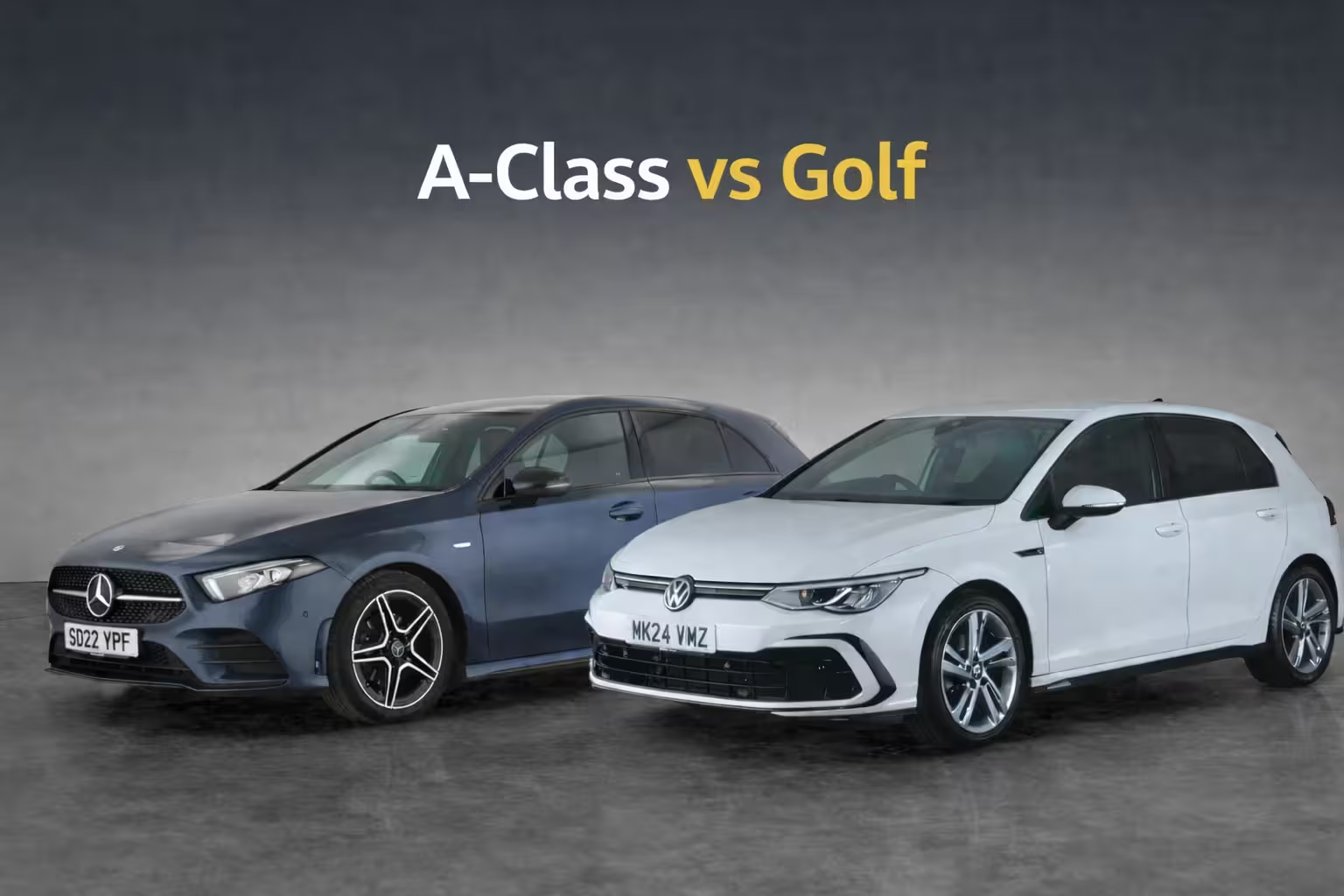
It's one of the most hotly debated choices in the used car market: the premium allure of the Mercedes-Benz A-Class versus the no-nonsense brilliance of the Volkswagen Golf. Both are five-door hatchbacks, both compete for a similar buyer, and both have spent decades perfecting their formula.
But they are very different cars — and which one suits you depends entirely on what you prioritise. This guide cuts through the noise, compares every key category, and rounds off with real A-Classes and Golfs currently available at Carsa.
Quick verdict
If you want the most practical, refined, and affordable-to-run family hatchback, the Volkswagen Golf is the smarter choice for most buyers. Its larger boot, better rear space, smoother ride, and lower running costs make it the all-rounder benchmark it has always been.
If you want a car that feels like a step up — a cabin that turns heads, a badge that carries weight, and a connection to the Mercedes family — the A-Class delivers that in abundance, especially in AMG Line trim.
Both are excellent used buys. The question is: what matters more to you?
At a glance: key specs compared
Design: premium presence vs timeless confidence
The Mercedes-Benz A-Class was designed to make an impression. The W177 generation brought the design language of the S-Class into a small hatchback — wide twin headlights, a diamond-pattern grille, and a low, athletic stance courtesy of its standard sport suspension. In AMG Line trim, 18-inch alloys, a subtle bootlid spoiler, and twin tailpipes push the visual drama further. Park one next to a Golf and the difference is immediately apparent: the A-Class looks like a premium car.
The Volkswagen Golf takes the opposite approach. Clean, confident, and never out of fashion — the Mk8 Golf has been refined over eight generations into something that simply looks right. The flush door handles and sharp LED lighting on higher trims add a contemporary edge, but the Golf doesn't shout. It doesn't need to. If you're after understated quality rather than visual drama, the Golf is the one.
In short: choose the A-Class if presence matters, the Golf if you want something that ages quietly and gracefully.
Interior & technology: MBUX magic vs Golf's quiet quality
This is where the A-Class makes its most compelling argument. The MBUX infotainment system — with its dual screens running uninterrupted across the dashboard — is a genuinely dramatic piece of interior design. Combined with ambient lighting, sports seats, and materials that borrow heavily from the E-Class and C-Class playbooks, the A-Class cabin feels like nothing else in the segment. From 2019 onwards, the 10.25-inch dual widescreen arrangement became standard on AMG Line models, and the overall quality of switchgear and surfaces is clearly a step above the mainstream competition.
The Golf's interior is less theatrical, but don't mistake restraint for inferiority. Build quality is excellent — panels fit tightly, switchgear operates with satisfying precision, and the materials feel durable and honest. The one significant black mark on early Mk8 Golfs (2020–2021) was the controversial touch-sensitive controls replacing physical buttons for climate and audio. VW partially walked this back in the 2024 facelift, restoring some physical controls — and most used examples from 2022 onwards had software updates that improved the responsiveness. It's worth checking any specific car you're considering.
Both cars support Apple CarPlay and Android Auto as standard. The MBUX system has a slight edge in display quality and voice command capability; the Golf's system is more intuitive to use day-to-day.
Mercedes-Benz A-Class — from Carsa's stock
Browse all Mercedes-Benz A-Class cars at Carsa →
Practicality: the Golf pulls ahead
This is the category where the Golf most convincingly wins, and it matters for real-world ownership.
The Volkswagen Golf offers genuine rear-seat comfort for two adults on longer journeys — headroom and legroom are both excellent in the Mk8, building on the improved packaging of the Mk7. Front seat space is similarly spacious, with a low dashboard line giving a light, airy feel.
The Mercedes A-Class is more compromised at the back. Taller adults will notice the restricted legroom, particularly in the hatchback body style. The A-Class Saloon version (available from 2019) addresses this with a longer wheelbase, significantly improving rear passenger comfort — if rear space is a priority and you prefer the saloon body, this is well worth considering. The Carsa stock shown above includes both body styles.
Boot space: the Golf delivers 381 litres, the A-Class Hatchback 370 litres — so the gap is modest in raw numbers. However, the Golf's boot opening is wider and more rectangular, making it easier to load. Golf Estate variants push this to 611 litres if you need maximum carrying capacity.
Driving experience: two different philosophies
The A-Class drives with an underlying sportiness that reflects its low, lowered stance. There's good body control, a sense of rigidity through bends, and steering that feels alert if not especially communicative. The trade-off is that the ride — particularly on AMG Line models with their 18-inch alloys — can feel firm over urban potholes and rough surfaces. At motorway speeds it settles beautifully, but it's not the most forgiving car around town.
The Volkswagen Golf is the benchmark for refined everyday driving. Its suspension absorbs imperfections more willingly, the ride is consistently composed, and the refinement at motorway speeds is excellent. Golf R-Line models similarly run larger wheels and are slightly firmer than SE trim — but even then, the Golf handles everyday roads with more comfort than the A-Class in equivalent trim.
For engine refinement, the Golf's 1.5 eTSI mild hybrid is one of the smoothest and most efficient petrol engines in the segment — responsive, quiet, and effortlessly smooth through the DSG gearbox. The A-Class's 1.3T units are competent but occasionally feel strained at higher revs. Diesel models on both cars are excellent: the A180d and Golf 2.0 TDI are both smooth and extremely economical.
Performance variants: AMG 45 vs Golf R
If you're in the market for a hot hatchback, both cars offer seriously impressive performance variants.
The Mercedes-AMG A45 S produces 421bhp from its 2.0-litre turbocharged engine — a genuinely remarkable figure for a car of this size, making it the most powerful four-cylinder production car in the world at launch. It's breathtakingly fast, with a 0–62mph time of 3.9 seconds. But it comes with significant running costs: premium insurance groups, servicing at Mercedes main dealers, and fuel consumption that's hard to keep under 30mpg.
The Volkswagen Golf R produces 320bhp, employs 4Motion all-wheel drive and a 7-speed DSG transmission, and hits 62mph in 4.7 seconds. It's slightly less explosive than the AMG but arguably more rewarding to drive every day — more tractable at lower speeds, better in the wet thanks to all-wheel drive, and considerably cheaper to insure and maintain. The Golf R at Carsa (MT24PZB, 2024, only 4,366 miles) represents outstanding value for this level of performance.
At the mid-performance tier, the A35 AMG (306bhp, AWD) and the Golf GTI (245bhp, FWD) offer a more accessible slice of hot hatch capability.
Volkswagen Golf — from Carsa's stock
Browse all Volkswagen Golf cars at Carsa →
Running costs: what does it cost to own one?
Reliability: what the data says
Volkswagen sits comfortably in the mid-table of manufacturer reliability surveys — a solid, consistent performer. The Mk8 Golf had a troubled launch, with early software bugs in the touchscreen and connectivity systems drawing significant criticism in 2020–2021. Most of these were addressed through software updates, and 2022-onwards cars are substantially improved. The DSG gearbox has an excellent long-term track record when properly serviced.
The Mercedes-Benz A-Class W177 showed improvement over the previous W176 generation, but Mercedes as a brand has historically sat lower in reliability rankings than Volkswagen. The MBUX system is generally dependable, though early examples occasionally experienced infotainment glitches. As with all premium cars, out-of-warranty repair bills are notably higher than their mainstream equivalents — budget accordingly.
Both cars are now comfortably beyond their factory three-year warranties. Carsa's 90-day warranty is included with every car as standard, with Platinum Cover extended warranty available as an upgrade — worth considering for either of these cars if peace of mind is important to you.
Safety: both excellent
The Mk8 Golf received a five-star Euro NCAP rating in 2020 with strong scores across all categories, including 91% for adult occupant protection. It comes with automatic emergency braking, lane-keeping assist, and adaptive cruise control as standard across the range.
The A-Class W177 also holds a five-star Euro NCAP rating (2018). All models include autonomous emergency braking and a comprehensive suite of active safety features. Higher trim levels add active lane change assist and Active Brake Assist that can identify pedestrians and cyclists.
On safety grounds, both are genuinely excellent choices and represent the best of what their respective launch years could offer.
Pros and cons
Which should you buy?
Buy the Mercedes-Benz A-Class if: the interior experience matters more to you than rear legroom. If you want a car that feels genuinely premium from the moment you sit down — a cabin that impresses passengers, an infotainment system that draws comments, and a badge that carries real prestige — the A-Class is a unique proposition at this price point. The A-Class Saloon resolves most of the practicality concerns of the hatchback. And the A250e plug-in hybrid is outstanding value if you charge regularly.
Buy the Volkswagen Golf if: you need the most complete, most practical, most effortless family car available in this segment. Better rear space, smoother ride, lower running costs, stronger residuals, and an engine range that now includes excellent mild-hybrid efficiency — the Golf does more, for less, every day. If you cover high mileage, have regular rear passengers, or simply want the lowest total cost of ownership, the Golf wins convincingly.
Both cars are priced on average £700 below market value at Carsa — checked daily, never haggled. Every car comes with a 90-day warranty as standard and finance from 8.9% APR representative. Reserve any car online today and collect from your nearest store.
Related articles



Ready to find your next car?
Browse hundreds of expertly prepared used cars — all fully checked, cleaned, and ready to drive away.
Talk to us, anytime.
Our friendly team is just a message or call away.
Message us on whatsapp, 24/7