
Which tyres extend EV range? A complete guide for UK drivers in 2026
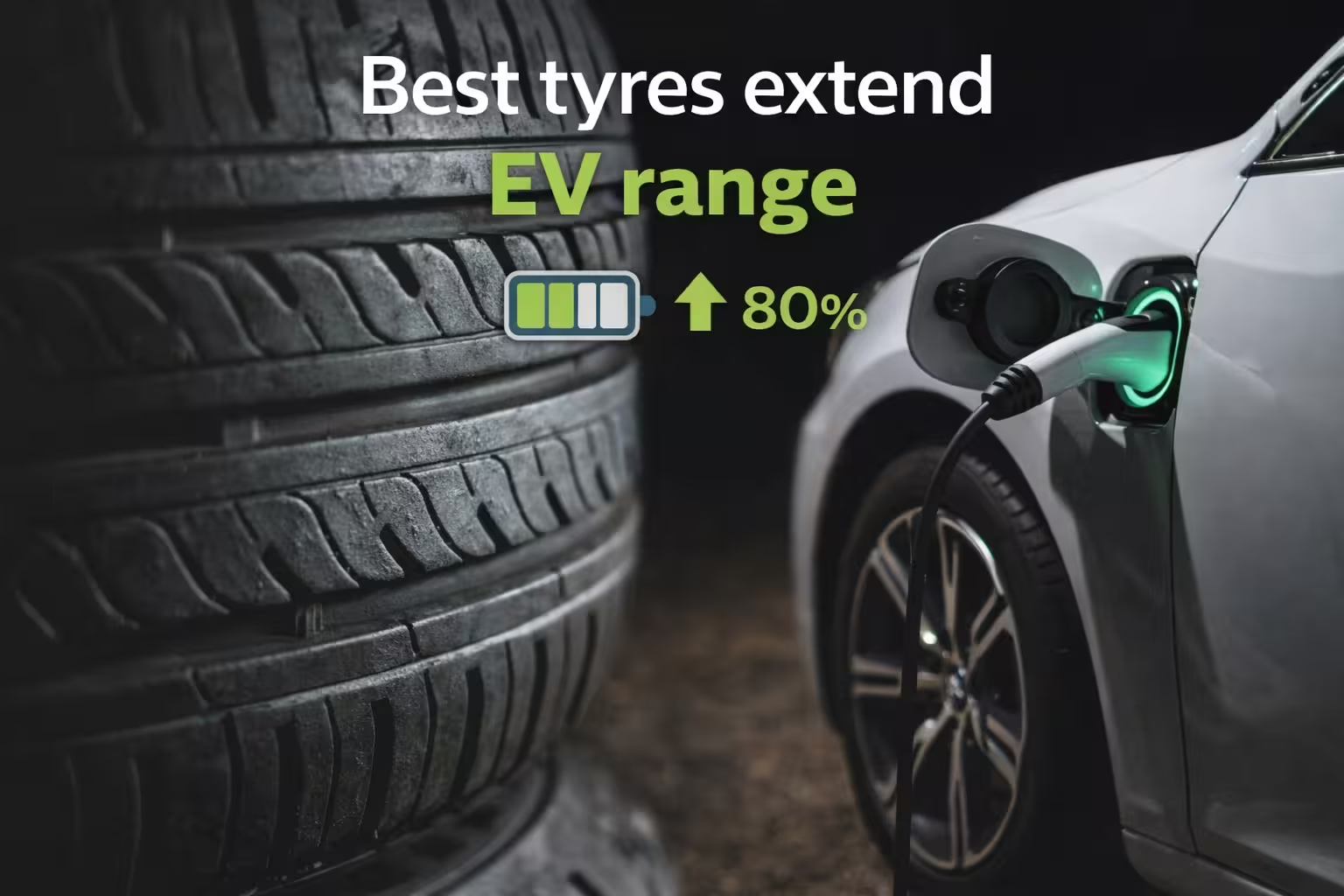
Most EV owners think about charging infrastructure, battery health, and driving style when they want more range. Few think about tyres — but they probably should. Independent testing consistently shows that tyre choice can affect an EV’s real-world range by 10–16%, and in some tests the spread between the best and worst tyre in the same size, fitted to the same car, has been as wide as 65km (40 miles) on a single charge. That’s the equivalent of adding a meaningful buffer to every journey — for free, every time you drive.
This guide explains why tyres matter more for EVs than for petrol or diesel cars, what acoustic foam inside tyres actually does, and which tyres the independent tests in 2025 and 2026 consistently rank highest for EV range extension in the UK.
Why tyres matter more for EVs than for petrol cars
In a petrol or diesel car, tyre rolling resistance is one energy loss among many — the engine, gearbox, exhaust system, and drivetrain collectively waste far more energy than the tyres. A 5% improvement in rolling resistance makes a modest difference when the engine is only 35% thermally efficient to begin with.
In an electric car, the powertrain is around 85–95% efficient. There’s very little waste elsewhere. Rolling resistance — the energy consumed just by keeping the tyres turning and deforming under the car’s weight — accounts for approximately 10% of total EV energy use, a proportionally far larger share than in an equivalent combustion car. When tyre rolling resistance is your primary energy loss, improving it has a disproportionate effect on range.
There’s a second factor that’s specific to EVs: their weight. A full-size EV battery pack weighs 350–600kg, and the car as a whole typically weighs 20–30% more than a comparable petrol car. Heavier cars generate more rolling resistance and wear tyres faster. EV-specific tyres are engineered with reinforced sidewalls, higher load ratings, and compounds that manage the instant torque delivery of electric motors — which can overwhelm a standard tyre’s shoulder in a way that a petrol engine’s power delivery doesn’t.
The third factor is noise. A petrol engine masks a substantial amount of tyre and road noise through mechanical harmonics. An EV is near-silent in normal driving, which means any tyre noise is immediately audible and disproportionately intrusive. This is why acoustic technology has become a central differentiator in EV-specific tyre development.
What is rolling resistance and how is it measured?
Rolling resistance is measured in kilograms per tonne (kg/t) — the force required to keep a loaded tyre rolling at constant speed on a flat surface. Lower is better. In the 2025 AutoBild EV tyre test conducted on a Hyundai Kona EV, the spread between the best-performing tyre (Falken e.Ziex at 5.86 kg/t) and the worst (Continental EcoContact 6 at 7.66 kg/t) was 1.80 kg/t — a 30.7% difference that translated directly into a 65.6km range gap between those two tyres on the same car.
On the EU tyre label — required on all tyres sold in the UK — rolling resistance is graded from A (best) to G (worst). For EV drivers prioritising range, an A rating is the target. An A-rated rolling resistance tyre paired with at least a B rating for wet grip is the sweet spot that most specialist EV tyre reviewers recommend: the efficiency gain is real, and the safety performance remains strong.
Real-world owner data broadly aligns with test results. Switching from a high-resistance tyre to a modern low rolling resistance EV tyre typically adds 5–10% range in mixed use — roughly 15–35 miles on a 300-mile car, on every charge. The Michelin e.Primacy, which has among the lowest rolling resistance in its class, is rated by Michelin as capable of adding approximately 7% range — around 18 miles on a 350-mile charge. Some manufacturers quote up to 8% under specific test conditions.
Acoustic foam: what is it, how does it work, and which brands use it?
Inside a tyre there is a hollow air cavity. When the tread contacts the road surface, the resulting vibrations cause the air inside this cavity to resonate — producing a low-frequency humming or booming sound that is amplified by the cavity’s drum-like acoustics. In a petrol car this noise is partially masked by engine and drivetrain sound. In an EV it is the dominant source of interior road noise, particularly at motorway speeds.
Acoustic foam technology addresses this by bonding a ring or strip of polyurethane foam to the inner liner of the tyre, directly below the tread surface. The foam absorbs the sound vibrations before they can resonate in the air cavity, reducing the noise that reaches the cabin through the wheel, axle, and chassis.
The key brands and their acoustic foam technologies are as follows.
Michelin Acoustic Technology (MAT) uses a custom polyurethane foam ring bonded to the inner tread surface. Michelin claims up to 20% reduction in interior cabin noise in certain frequency bands. MAT is typically developed in co-development with vehicle manufacturers as original equipment — meaning the foam quantity and specification is tuned to the resonance frequencies of a specific vehicle. Michelin also uses PIANO Noise Reduction Tuning (multi-pitch tread block sequencing) alongside MAT on its EV-specific tyres. The Michelin Pilot Sport EV and Pilot Sport EV Acoustic both incorporate MAT.
Continental ContiSilent uses a polyurethane foam insert bonded to the inner tread liner after the tyre production process. Continental claims up to 9 dB(A) reduction in the noise components perceived as most irritating inside the vehicle. To put this in context: the human ear perceives every 10 dB reduction as approximately halving the audible sound, so 9 dB is a very significant reduction. ContiSilent is compatible with all standard rims and does not affect load rating, speed rating, or driving performance. It is available on selected Continental sport and premium tyres and was fitted as original equipment to Tesla Model S and Model X performance variants.
Pirelli PNCS (Pirelli Noise Cancelling System) applies a sound-absorbing foam strip to the inner tyre liner. Pirelli claims noise reductions of up to 4 dB(A) and the technology is used on premium Pirelli fitments including the P Zero and Cinturato ranges. An independent test of the Pirelli PNCS on the Audi e-tron GT recorded a 20% reduction in highway-speed cabin noise.
Hankook Sound Absorber is used across Hankook’s iON EV-specific range and selected Ventus performance tyres. The sound-absorbing foam layer targets cavity resonance noise specifically and is marketed alongside Hankook’s reinforced EV-specific construction.
Yokohama Silentfoam is incorporated into the ADVAN Sport EV V108, targeting the same low-frequency cavity noise reduction approach as the other brands.
An important practical point: acoustic foam tyres can complicate puncture repair. Some tyre fitters — particularly smaller independent garages — will decline to plug or patch an acoustic foam tyre because the foam needs to be carefully cut back around the puncture site before repair and then re-bonded. This is documented and manageable, but it means acoustic foam tyres are best repaired by fitters familiar with the technology. Michelin and Continental both publish guidance on repairing foam-lined tyres; the process is not fundamentally different from a standard repair, but it requires an additional step.
Acoustic foam vs range: are they the same thing?
This is a common source of confusion worth clarifying directly. Acoustic foam and low rolling resistance are distinct tyre technologies that address different problems. Acoustic foam reduces cabin noise; it does not materially affect rolling resistance or range. Low rolling resistance compounds and construction reduce energy loss; they have minimal effect on cabin noise.
The best EV tyres combine both: a low rolling resistance compound and construction for range extension, plus acoustic foam for cabin quiet. The Michelin Pilot Sport EV Acoustic, for example, combines MAT foam with Michelin’s GreenPower compound for range efficiency. The Hankook iON evo Sound Absorber combines the iON’s low rolling resistance EV-specific compound with the Sound Absorber foam layer. If you want both range and quiet, look for tyres that explicitly combine both technologies — not just one.
The best EV tyres for range in the UK in 2026
Michelin e.Primacy — the range benchmark
The Michelin e.Primacy is the most consistently recommended EV tyre for drivers whose primary concern is maximising range. It has the lowest rolling resistance in its class and an A/B EU label (A for rolling resistance, B for wet grip) — an A/B pairing achieved by less than 1% of all summer car tyres sold in Europe, according to Michelin. Independent tests in 2025 praised its very balanced driving dynamics, low noise, and high fuel efficiency.
The 7% range extension figure quoted by Michelin equates to approximately 18 extra miles on a 350-mile charge, on every journey. It maintains reliable wet grip as the tread wears — passing the European R117 wet braking approval test even at the equivalent of 30,000km of wear. Note that the e.Primacy does not include acoustic foam — its range performance comes from the compound and construction, not noise technology. For buyers who want acoustic foam alongside range performance, Michelin’s Pilot Sport EV Acoustic is the alternative.
Best for: EV owners prioritising maximum range in everyday and mixed driving. EU label: A/B (rolling resistance/wet grip). Range claim: Up to 7% more than standard equivalents. Acoustic foam: No. Sizes: 15–21 inch.
Hankook iON evo Sound Absorber — the best all-round EV tyre
The Hankook iON evo won the definitive 2025 AutoBild EV tyre test (conducted on a Hyundai Kona EV), beating seven other tyres including dedicated EV models from Continental, Goodyear, Michelin, and Falken. It achieved first place through outstanding wet and dry performance: excellent wet braking (39.6m), strong dry braking (33.6m), good aquaplaning resistance, and a projected lifespan of 43,120km — significantly higher than most competitors. Its rolling resistance of 6.81 kg/t delivered an estimated range of 381.3km in the test.
The Sound Absorber version adds the acoustic foam layer to the iON evo’s already strong base construction. For EV buyers who want a tyre that doesn’t require compromising between range, safety, longevity, and quiet — the iON evo Sound Absorber is the most rounded recommendation. Hankook is also the official tyre supplier for the Formula E World Championship, which has influenced the EV-specific compound development across the iON range.
Best for: Buyers wanting the best balance of safety, range, longevity, and acoustic comfort. EU label: B/A (rolling resistance/wet grip). Acoustic foam: Yes (Sound Absorber). 2025 test: 1st place, AutoBild EV tyre test.
Falken e.Ziex — lowest rolling resistance in 2025 testing
The Falken e.Ziex recorded the lowest rolling resistance (5.86 kg/t) in the 2025 AutoBild test, which translated into the highest calculated range of 410km — 65.6km more than the Continental EcoContact 6 in the same test. It carries an A/A EU label (A for both rolling resistance and wet grip), which is extremely rare. The e.Ziex incorporates Silent Core noise-absorbing technology (Falken’s version of acoustic foam), contains up to 29% sustainable and recycled materials, and features an optimised tread profile for uniform contact pressure under EV loads.
The Falken brand has lower recognition in the UK than Michelin or Continental, but the e.Ziex’s test performance in 2025 is genuinely impressive. It won a price-performance recommendation from Auto Motor und Sport in 2025 and is a strong recommendation for range-conscious EV owners who want to explore beyond the major premium brands.
Best for: Range-first buyers wanting maximum efficiency. EU label: A/A. Acoustic foam: Yes (Silent Core). Sustainable materials: Up to 29%. 2025 test: Lowest rolling resistance, highest calculated range.
Michelin Pilot Sport EV Acoustic — the performance EV tyre
The Pilot Sport EV Acoustic is Michelin’s premium performance EV tyre, drawing on Formula E racing experience and combining the GreenPower compound (for range efficiency) with Michelin Acoustic Technology foam (for cabin quiet) and a reinforced construction designed for the higher cornering loads of performance EVs. It is available in larger rim sizes (18–21 inch) and suits performance-focused EVs including higher-specification Tesla models.
Where the e.Primacy prioritises range efficiency and everyday driving, the Pilot Sport EV prioritises performance dynamics alongside efficiency. For buyers of quick EVs — Model 3 Performance, Model Y Performance, BMW iX, Polestar 2, Hyundai Ioniq 6 AWD — who want a tyre that matches the car’s performance character while retaining EV range credentials, this is the right choice.
Best for: Performance EVs where handling and range both matter. Acoustic foam: Yes (MAT). Sizes: 18–21 inch performance fitments.
Continental EcoContact 6 — the broad-compatibility option
The Continental EcoContact 6 is available in a very wide size range (13–23 inch) and carries A–C EU label ratings for rolling resistance and wet grip depending on size. It uses Continental’s Green Chili 2.0 compound, which Continental claims delivers 15% lower rolling resistance and 20% higher mileage than its predecessor. It is available in selected sizes with ContiSilent acoustic foam.
The EcoContact 6 ranked last for range in the 2025 AutoBild test (344.4km vs Falken’s 410km), which reflects its prioritisation of grip over pure efficiency. However, its width of availability — covering small city EVs through to larger premium EVs — and Continental’s UK dealer network make it a practical choice for owners whose specific tyre size isn’t available in the more focused EV-specific ranges. For those where ContiSilent is available in the right size, it adds meaningful acoustic improvement.
Best for: Owners needing broad size availability and a trusted brand. EU label: A–C (size-dependent). Acoustic foam: Available in selected sizes (ContiSilent). Note: Lower range efficiency than the specialist EV tyres above.
Bridgestone Turanza Eco — the factory-fit efficiency tyre
The Bridgestone Turanza Eco uses Bridgestone’s ENLITEN technology, which reduces rolling resistance by 30%, tyre weight by 20%, and raw material use by up to 2kg per tyre compared to its predecessor. It is the original equipment tyre on the Skoda Enyaq and several other European EVs. It carries an A/B EU label and suits everyday driving rather than performance use. For owners replacing worn factory-fit tyres who want to stay close to the original specification and efficiency profile, the Turanza Eco is the logical choice.
Best for: Owners replacing OE fitments who want equivalent or better efficiency. EU label: A/B. OE fitment: Skoda Enyaq and others.
Goodyear ElectricDrive 2 — the sustainability-rated option
The Goodyear ElectricDrive 2 (EfficientGrip 2 SUV in its SUV variant) was awarded AutoBild’s Green Tyre 2025 environmental seal for its balance of rolling resistance, longevity, and environmental characteristics. It incorporates SoundComfort technology (Goodyear’s acoustic foam variant) and uses sustainable materials in its construction. It is not the outright range leader but represents a strong, well-balanced choice for everyday EV SUV use.
Best for: EV SUV owners balancing efficiency, longevity, and environmental credentials. Award: AutoBild Green Tyre 2025.
What to look for when buying EV tyres
The EU tyre label should be your starting point. Focus on rolling resistance (A is the target for range), wet grip (B minimum recommended for UK driving conditions), and the external noise value in decibels. Note that the external noise figure on the label measures noise outside the vehicle, not inside — acoustic foam technology is not reflected in this figure.
Check for EV-specific load ratings. Many EVs require EL (Extra Load) or HL (Heavy Load) rated tyres to handle the additional weight of the battery pack. Fitting a standard load-rated tyre where an EL or HL is specified is potentially unsafe and will void your tyre warranty. Check your vehicle’s handbook or door placard for the required load index.
Tyre markings matter on EVs with specific OE fitments. Look for codes such as EV (electric vehicle specific), HL (heavy load), AO (Audi original), MO (Mercedes original), TES (Tesla specific), or POR (Porsche original). These indicate the tyre was developed or tuned for a specific vehicle and will often perform better on that car than an equivalent tyre without the mark.
On tyre pressure: EV tyres should be maintained at the manufacturer’s specified pressure consistently. A tyre that is 10% under-inflated increases rolling resistance by approximately 1–2% and reduces range. For high-mileage EV drivers, checking tyre pressure monthly rather than quarterly is a simple habit that materially protects range.
Budget EV tyres: are they worth the saving?
The 2025 AutoBild test included the Goodride Solmax 1 as the budget representative. It recorded the longest wet braking distance (48.7m), the weakest handling, and a projected lifespan of 31,030km — significantly shorter than the Hankook iON evo’s 43,120km. It received a “conditionally recommended” rating, placing it last. The rolling resistance was moderate (7.22 kg/t) and the range modest (373.2km).
The practical implication for EV owners is that a budget tyre saves money at purchase but typically delivers shorter lifespan (meaning more frequent replacement), higher rolling resistance (meaning less range per charge), and weaker safety performance in wet conditions — which are a defining feature of UK driving. For an EV where range and safety are both higher-stakes concerns than in a petrol car, the case for mid-premium or premium EV-specific tyres is stronger than it is for a budget petrol hatchback.
Find a used EV at Carsa
Carsa regularly stocks a wide range of used electric and hybrid vehicles, all priced on average £700 below market value and comprehensively inspected before sale. Every car comes with a 90-day warranty as standard, and finance is available from 8.9% APR representative. Carsa is a credit broker, not a lender.
Browse used electric cars at Carsa →
Related articles
.png)

.png)
Ready to find your next car?
Browse hundreds of expertly prepared used cars — all fully checked, cleaned, and ready to drive away.
Talk to us, anytime.
Our friendly team is just a message or call away.
Message us on whatsapp, 24/7