
Range anxiety: is it still a real problem for used EV owners in 2026?
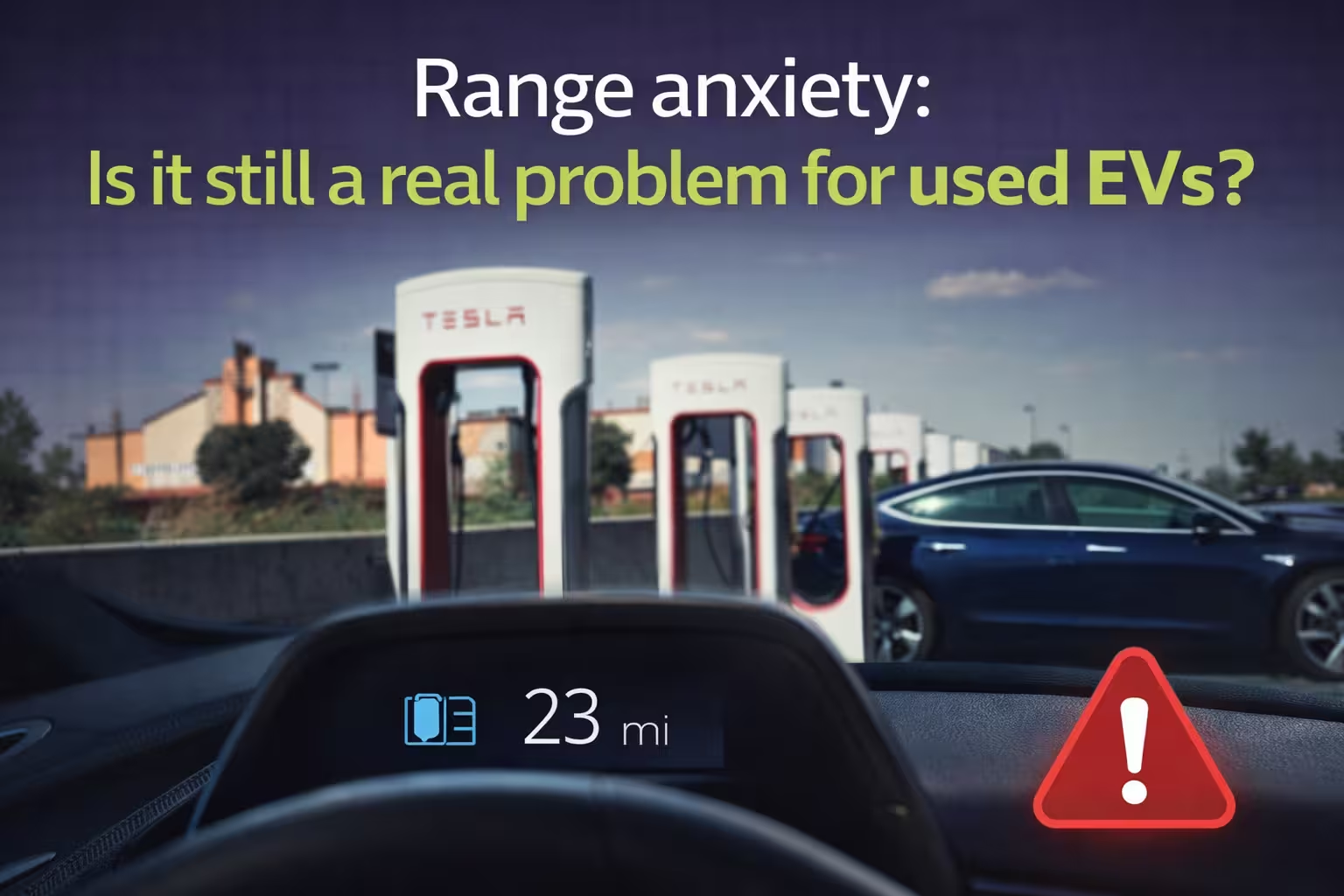
Range anxiety — the fear of running out of charge before reaching a destination or a charger — has been the single most cited barrier to electric car adoption in the UK for over a decade. In 2019 it was a genuinely legitimate concern: the public charging network was sparse, unreliable, and slow; most affordable EVs offered real-world range of 120–160 miles; and the experience of planning a longer journey in an electric car was meaningfully more stressful than in a petrol equivalent.
In 2026, the picture is substantially different. The UK public charging network has grown dramatically. Rapid and ultra-rapid chargers now cover most major routes. The real-world range of popular used EVs available at accessible prices has increased significantly. And a generation of EV owners has developed practical habits that make range management as routine as knowing when to fill up a petrol tank.
Range anxiety hasn’t disappeared entirely, and for a specific set of drivers and journeys it remains a genuine consideration. But for most UK drivers doing most UK journeys, it is no longer the barrier it once was. This article explains why — and gives you the information to assess honestly whether an EV works for your specific situation.
The UK charging network in 2026: how much has it changed?
The transformation of the UK’s public charging infrastructure since 2020 is one of the more significant changes in the UK transport landscape of the past five years. Several facts are worth knowing.
The number of publicly available charging devices in the UK has grown from around 17,000 in early 2020 to over 70,000 by 2026, with rapid growth concentrated on the motorway and A-road network. Motorway services charging, specifically, has transformed: virtually all major motorway service areas now have multiple rapid (50kW+) or ultra-rapid (150kW+) chargers. The days of arriving at a motorway services to find two slow 7kW chargers is largely historical on primary routes.
The key networks — Gridserve, BP Pulse, Osprey, Pod Point, Tesla Supercharger (now open to non-Tesla vehicles), and others — have built significant ultra-rapid charging hubs at motorway locations. Many of these offer 150–350kW charging, which means a 20–80% charge on a modern EV with an 800V architecture (Kia EV6, Hyundai Ioniq 5 and 6, Porsche Taycan) takes around 18–25 minutes — broadly comparable to a motorway fuel stop.
The honest caveats remain. Rural charging coverage is less comprehensive than motorway coverage. Charger reliability has improved but is not perfect — a broken charger in a rural area is a more significant problem than a broken one at a motorway services with multiple alternatives. Payment systems and apps across different networks remain fragmented, though aggregator apps like Zap-Map, Octopus Electroverse, and Bonnet have made multi-network access simpler. And destination charging — at hotels, supermarkets, car parks — is widespread in urban and suburban areas but remains patchy in rural ones.
The overall picture: for drivers whose journeys primarily involve motorway and A-road driving in England and Wales, the charging network in 2026 is genuinely adequate for most trips. For drivers who regularly travel to remote rural areas, range planning requires more thought.
UK public chargers
118,321
March 2026
Growth in 14 months
+15.1%
+15,550 since Jan 2025
Rapid 50kW+ chargers
27,009
22.8% of total · grew +17.4%
Charging devices (points)
89,842
3× growth since March 2022
Chargers per 100,000 people
By region & country · March 2026
Charging devices growth
UK total · March 2022 – March 2026
Source: Department for Transport / OZEV, Zapmap, March 2026.
Slow standard chargers (3–7kW)
49.8%
of all UK public chargers
En-route chargers that are rapid
89.1%
vs just 4% of on-street chargers
Supermarket vs forecourt
7,394 vs 4,393
supermarkets beat petrol stations
Chargers by speed (power band)
UK public network · January 2026
Standard 3–7kW · 49.8%
Standard plus 8–49kW · 27.5%
Rapid 50–149kW · 12.5%
Ultra-rapid 150kW+ · 10.3%
Where chargers are located
Top 10 location types · January 2026
The on-street charging gap
Share of chargers that are 50kW+ rapid · by location type · January 2026
En-route
motorway / A-road
89.1%
9,369 of 10,511
Destination
car parks, retail
23.1%
14,535 of 62,841
Other
mixed use
18.7%
952 of 5,092
On-street
kerbside / lamp post
4.0%
1,522 of 37,608
On-street chargers are the main option for the ~40% of UK households without a driveway — yet only 1 in 25 is rapid. En-route chargers at motorway services are almost exclusively rapid by design.
Source: Department for Transport / Zapmap, January 2026.
Real-world range on popular used EVs
Official range figures (WLTP) on EVs are typically optimistic by 15–25% compared to real-world results in UK conditions. A car claiming 300 miles WLTP will typically deliver 230–260 miles in mixed real-world use at legal speeds in mild weather. In winter, at motorway speeds, the real-world range can drop to 65–70% of WLTP. Understanding these figures is more useful than the headline WLTP number for planning actual journeys.
Here are honest real-world range estimates for popular used EVs available in the UK market, based on typical mixed UK driving conditions (not motorway-only, not urban-only):
Real-world range comparison — 10 models
WLTP official
Mixed real-world
Motorway 70mph
Winter motorway
Range king
Tesla Model 3 Long Range
2020–22 · Saloon
The range benchmark at this price. Supercharger network access is a meaningful additional advantage.
Long Range
Tesla Model Y Long Range
2022–23 · SUV body penalty
SUV body reduces efficiency ~6% vs the Model 3. More space and higher ride position in return.
77.4 kWh
Kia EV6 Long Range RWD
2022–23
⚡ 800V — 80% in ~18 min
800V architecture makes long-distance stops significantly faster than most rivals. Strong long-run case.
73 kWh
Hyundai Ioniq 5
2022–23
⚡ 800V — ultra-rapid charging
Same 800V platform as EV6. Boxy, practical body — better interior space than its range figures suggest.
77.4 kWh
Hyundai Ioniq 6 RWD
2023–24 · Most aero-efficient
Cd 0.21 makes it the most efficient on this list at motorway speeds. Excellent motorway range per kWh.
58 kWh
Volkswagen ID.3
2022–23 · Commuter-focused
Suited to daily commuting and suburban driving. Think carefully before using for regular long motorway runs.
64 kWh
MG MG4 Extended Range
2023–24 · Best value/mile
Strong range for its used purchase price. Competitive on cost-per-mile against much more expensive rivals.
40 kWh
Nissan Leaf
2019–23 · Local use only
Range limits it to local use. Outstanding reliability record and accessible used price compensate significantly.
52 kWh
Renault Zoe R135
2020–23 · Urban/suburban
Better urban than motorway. Always confirm battery is owned not rented (check V5C) before purchasing.
50 kWh
Peugeot e-208
2020–22 · City-first design
Distinctive Peugeot interior quality for the class. Best suited to urban and suburban driving within range limits.
Reading these numbers: WLTP figures are official test-cycle results — real-world range is always lower. Motorway driving at 70mph uses 30–40% more energy than mixed use. Cold weather (below 5°C) reduces battery capacity by a further 20–30%. Plan longer journeys using mixed real-world figures, not WLTP.
The honest question: does range anxiety apply to your driving?
The most useful thing you can do before buying a used EV is to be precise about your actual driving patterns rather than your worst-case imagined driving. Most UK drivers dramatically overestimate how often they’d need to worry about range.
The average UK daily driving distance is around 21 miles. Even the shortest-range EV on this list — the Nissan Leaf 40kWh with real-world range of 120–145 miles — covers nearly a week of average UK driving on a single charge. If you have home or workplace charging, the car charges overnight and you start every day at full range. You don’t think about range at all for daily driving.
The situations where range requires active planning are specific: journeys of 150+ miles on motorways, particularly in winter; destinations where charging isn’t available at the other end; and time-pressured situations where you can’t afford a charging stop. For buyers who regularly make long motorway journeys without flexibility to stop for 20–30 minutes, a higher-range used EV or a PHEV may be more appropriate than an entry-level EV.
For buyers who do primarily urban and suburban driving with occasional longer trips, a mid-range used EV with 200–260 miles of real-world range is broadly adequate for the vast majority of journeys, with longer trips requiring a single planned charging stop at a motorway services.
Home charging: the factor that changes everything
The most significant practical division in EV ownership is not between different cars — it’s between drivers who can charge at home and drivers who can’t.
With a home 7kW wallbox (typically £700–£1,000 installed including the OZEV grant if eligible), you wake up every morning to a full battery. The average overnight charge cost at a standard electricity tariff is approximately £4–6 for a full charge on a 64–77kWh battery. Running costs drop to 2–5p per mile depending on your electricity tariff. Range anxiety for daily driving is eliminated entirely — the car charges while you sleep.
Without home charging — for drivers in flats or terraced houses without off-street parking — the calculation changes. You’re relying on public charging for all your charging needs, which is more expensive (20–35p per kWh at rapid chargers vs 7–12p at home), less convenient, and more susceptible to charger availability. The running cost advantage of an EV narrows significantly. This doesn’t make an EV impossible without home charging, but it makes the decision more nuanced and the choice of car (prioritising fast public charging capability) more important.
Practical strategies for longer EV journeys
EV drivers who regularly make longer journeys develop habits that make range management routine rather than stressful. These are the most consistently useful.
Plan charging stops, not maximum range. The most experienced EV drivers don’t think about range — they think about charging stops, in the same way they’d plan a long petrol journey with a fuel stop. Apps like Zap-Map, A Better Routeplanner (ABRP), and built-in navigation systems on modern EVs route you automatically via charging stops, showing you exactly where to stop and for how long based on your current battery level and speed.
Charge to 80%, not 100%, for long trips. EV batteries charge fastest between 20–80% state of charge — the charging curve slows significantly above 80%. On a long journey, stopping at 80% and continuing is usually faster overall than waiting for 100%. Tesla’s navigation and Hyundai/Kia’s multi-charger routing both handle this automatically.
Use regenerative braking actively. One-pedal driving — using regenerative braking to slow the car rather than the friction brakes — recovers energy on every deceleration. In urban driving, regenerative braking can add 15–25% to effective range. Drivers who’ve learned to drive smoothly and anticipate stops recover significantly more energy than drivers who brake late.
Motorway speed affects range more than any other single factor. At 60mph, most EVs deliver close to their WLTP range. At 70mph, real-world range typically drops by 10–15%. At 80mph (above the UK speed limit), range drops by 20–30% over WLTP. A Tesla Model 3 Long Range at 60mph can cover over 300 miles; at 80mph, the same car might cover 210 miles. Adjusting motorway cruise speed has a larger impact on range than almost any other variable.
Pre-condition the battery in cold weather. EV batteries operate less efficiently when cold. Pre-conditioning — warming the battery while still plugged in at home before departure — significantly reduces the range penalty from cold weather. Most modern EVs support pre-conditioning via the app or scheduled departure time.
Which used EV suits which driving pattern?
A straightforward way to think about it: if you primarily drive locally with occasional longer trips and have home charging, almost any used EV works — even the shorter-range options like the Nissan Leaf or Renault Zoe cover daily commuting comfortably. If you regularly make long motorway journeys, prioritise used EVs with 250+ miles of real-world range and 100kW+ DC rapid charging capability. The Tesla Model 3 and Model Y, Kia EV6, Hyundai Ioniq 5 and 6, and BMW i4 all meet this threshold.
Battery degradation on used EVs is worth checking: a battery health report (available from the relevant dealer, or from third-party services for some models) tells you the battery’s current state of health as a percentage of original capacity. A Tesla Model 3 at 90% SoH has roughly 90% of its original range — still very usable. Most well-maintained 2019–23 EVs show above 85% SoH at resale.
Find a used electric car at Carsa
Carsa stocks a wide range of used electric cars from the most popular models — Tesla, Kia, Hyundai, Volkswagen, and more — all priced on average £700 below market value and comprehensively inspected before sale. Every car comes with a 90-day warranty as standard, and finance is available from 8.9% APR representative.
Browse used electric cars at Carsa →
Related articles
.png)

.png)
Ready to find your next car?
Browse hundreds of expertly prepared used cars — all fully checked, cleaned, and ready to drive away.
Talk to us, anytime.
Our friendly team is just a message or call away.
Message us on whatsapp, 24/7