
What is adaptive cruise control and how does it work?
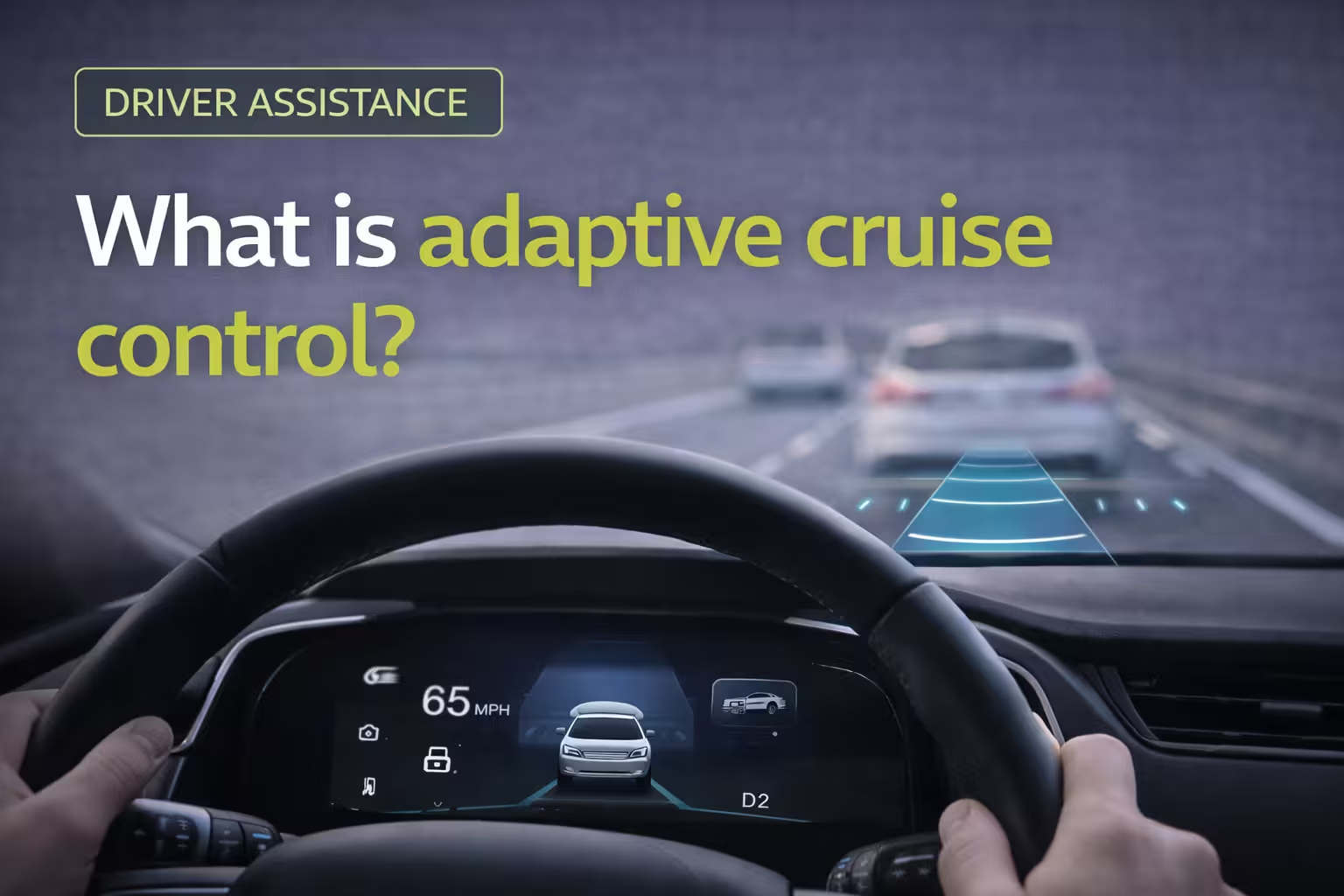
Cruise control has been around for decades. Set a speed, take your foot off the accelerator, and the car holds it for you. Useful on long motorway runs, but limited — as soon as traffic ahead slows, you have to intervene manually. Adaptive cruise control solves that problem. It reads the road ahead, monitors the vehicle in front, and adjusts your speed automatically to maintain a safe following distance. It's one of the most genuinely useful driver assistance technologies fitted to modern cars, and it's now standard or available on most vehicles built since around 2018.
Here's a clear explanation of how it works, what the different versions do, and what you should know when buying a used car that has it.
How does adaptive cruise control work?
Standard cruise control uses a simple throttle system: you set a target speed and the car maintains it regardless of what's happening ahead. Adaptive cruise control (ACC) adds a sensor — typically a forward-facing radar, camera, or combination of both — that monitors the vehicle in front and adjusts your speed automatically to keep a set gap.
If the car ahead slows down, your car slows with it, reducing throttle and applying gentle braking as needed. When the car ahead speeds up or moves out of your lane, your car accelerates back to the target speed you originally set. The following gap is typically adjustable — most systems offer three or four settings from a shorter urban gap to a longer motorway gap — and is measured in time (seconds of following distance) rather than a fixed distance in metres.
The sensing technology varies by manufacturer and model year. Radar is the most common primary sensor — it's reliable in poor weather and low visibility conditions because it uses radio waves rather than light. Camera systems can identify vehicle types and read lane markings but are more affected by rain, glare, and darkness. Most modern systems from around 2020 onwards use a combination of forward radar and a front camera, which improves both object detection and response accuracy.
What's the difference between basic and advanced adaptive cruise control?
Not all adaptive cruise control systems are equal, and the differences are significant for everyday use.
Basic adaptive cruise control operates at motorway speeds only — typically above 30mph. It will slow the car down to maintain the following gap but has a lower limit: if traffic slows to a stop, the system disengages and the driver must brake to a halt and restart the system. This is the type fitted to older used cars and some entry-level variants of more recent models.
Stop-and-go adaptive cruise control (also called traffic jam assist or full-speed range ACC) works at all speeds including a complete stop. If the vehicle ahead brakes to a standstill, your car brakes to a standstill with it. When traffic moves off again, the car follows automatically — usually up to a few seconds of standstill, after which you tap the accelerator or a resume button to continue. This is significantly more useful in UK motorway and dual carriageway traffic jams, where the system removes the repetitive stop-start fatigue entirely.
Predictive or road-reading adaptive cruise control is the most advanced tier, available on higher-specification cars from around 2021 onwards. These systems use the navigation map data in combination with the radar and camera to anticipate what's ahead — slowing for bends, motorway junctions, speed limit changes, and roundabouts, not just for the vehicle immediately in front. Some systems also read speed limit signs and can automatically adjust the target speed when limits change. These feel significantly more natural and less intrusive than basic radar-only systems.
Does adaptive cruise control steer the car?
On its own, no — adaptive cruise control only manages speed and braking. Steering is a separate system. However, most modern cars pair adaptive cruise control with lane centring assist (also called lane keeping with steering support), which does add a degree of automatic steering input to keep the car in the centre of its lane.
The combination of adaptive cruise control and lane centring is commonly marketed under names like: BMW Active Cruise Control with Steering and Lane Control, Mercedes-Benz Active Distance Assist Distronic with Active Steering Assist, Volkswagen Travel Assist, Ford Co-Pilot360 with Active Drive Assist, and Tesla Autopilot. These combined systems are sometimes referred to as hands-free driving or semi-autonomous driving, though all current UK-legal systems require the driver to keep hands on the wheel and remain attentive.
On most cars, the steering assist component can be felt as a gentle corrective input rather than full steering control. If you drift towards a lane marking, the car nudges you back. It does not steer actively through corners or junctions.
Is adaptive cruise control the same as autonomous emergency braking?
No, though the two often use the same sensors. Autonomous emergency braking (AEB) is a safety system that intervenes to brake if an imminent collision is detected when the driver hasn't responded. It operates at speeds and in situations outside normal cruise control use — for example, approaching a stationary car at speed on a motorway, or a pedestrian stepping into the road in town.
Adaptive cruise control is a comfort and convenience feature the driver deliberately activates. AEB is a passive safety system that operates in the background regardless of whether cruise control is on. Most modern cars with ACC also have AEB, and they often share the same forward radar unit, but they serve different purposes.
How do you use adaptive cruise control?
The controls vary by manufacturer, but the basic process is consistent. Accelerate to your target speed, then activate the system using a dedicated button or stalk — usually on the steering column or wheel. The car will hold that speed. Set your preferred following gap using a separate button. From that point, the car manages speed automatically in relation to traffic ahead.
You can override the system at any time by pressing the accelerator to increase speed temporarily, or pressing the brake to slow manually. The system typically resumes your target speed once you release the pedal. To deactivate fully, press the cancel or off button, or press the brake firmly.
Most systems display the current ACC status on the instrument cluster — showing the target speed, the current speed, the following gap setting, and whether a lead vehicle has been detected. Knowing how to read these indicators helps you understand what the system is doing.
Are there situations where adaptive cruise control doesn't work well?
Yes, and understanding the limitations is as important as knowing the capabilities.
Motorway slip roads and junctions. When a vehicle joins the motorway ahead of you from a slip road, the radar may detect it at the last moment, causing a sharp braking response. Most drivers learn to increase following gap settings on busy sections with frequent junction entries.
Narrow lanes and roadworks. Temporary lane narrowing and roadworks can confuse camera-based lane assist components, and some basic systems don't reliably detect stationary vehicles in slow-moving roadwork queues. The driver should be prepared to take over.
Adverse weather. Heavy rain, snow, and mud on the front bumper can obstruct the radar sensor, causing the system to display a warning and disengage. Some systems have sensors embedded behind the Jaguar, Mercedes, or BMW badge on the front grille — worth knowing so you can keep it clear.
Motorcycles and cyclists. Older radar-only ACC systems have difficulty detecting motorcycles and cyclists due to their smaller radar cross-section. Combined radar and camera systems are significantly better. On any ACC-equipped car, you should never rely on the system as a substitute for your own awareness of vulnerable road users.
Cut-ins. When a vehicle cuts sharply into your lane ahead, the radar may not respond instantly, particularly if the cut-in is very close. The system is not a substitute for maintaining your own following distance awareness.
What's the difference between ACC and standard cruise control on a used car listing?
Standard cruise control maintains a fixed speed. Adaptive cruise control maintains a following gap. On used car listings, ACC may be described as: Adaptive Cruise Control, Active Cruise Control, Dynamic Radar Cruise Control (Toyota/Lexus), Intelligent Speed Limiter with ACC (Nissan), Distronic (Mercedes-Benz), or simply Traffic-Aware Cruise Control (Tesla).
If a listing says ‘cruise control’ without the word ‘adaptive’ or a brand-specific name, it's likely standard fixed-speed cruise control only. If you're specifically looking for ACC, it's worth verifying before purchase by checking the specification sheet or options list for the car, or asking the seller to confirm.
What used cars have adaptive cruise control?
Adaptive cruise control has become widespread across the market from around 2018 onwards. It was initially available only on premium brands as a paid option, but has progressively filtered down. By 2022–23, it was standard or available on most mainstream family cars at mid-range and above trim levels — including the Volkswagen Golf, Ford Focus, Vauxhall Astra, Toyota Corolla, Honda Civic, and Kia Sportage, among many others.
Stop-and-go capability — the full-speed range version — became widespread on mainstream cars from around 2020 and is standard on most mid-range variants of any car from 2022 or later. For older used cars, checking the specific trim level and options list is the only reliable way to confirm which type of ACC is fitted.
All our used cars at Carsa display full specification details online. If adaptive cruise control is listed in the features, our team can confirm the specific type — basic or stop-and-go — before you visit.
Find a used car with adaptive cruise control at Carsa
Carsa stocks a wide range of used cars with modern driver assistance technology, all priced on average £700 below market value and comprehensively inspected before sale. Every car comes with a 90-day warranty as standard, and finance is available from 8.9% APR representative.
Related articles


Ready to find your next car?
Browse hundreds of expertly prepared used cars — all fully checked, cleaned, and ready to drive away.
Talk to us, anytime.
Our friendly team is just a message or call away.
Message us on whatsapp, 24/7