
What is traction control and how does it work?
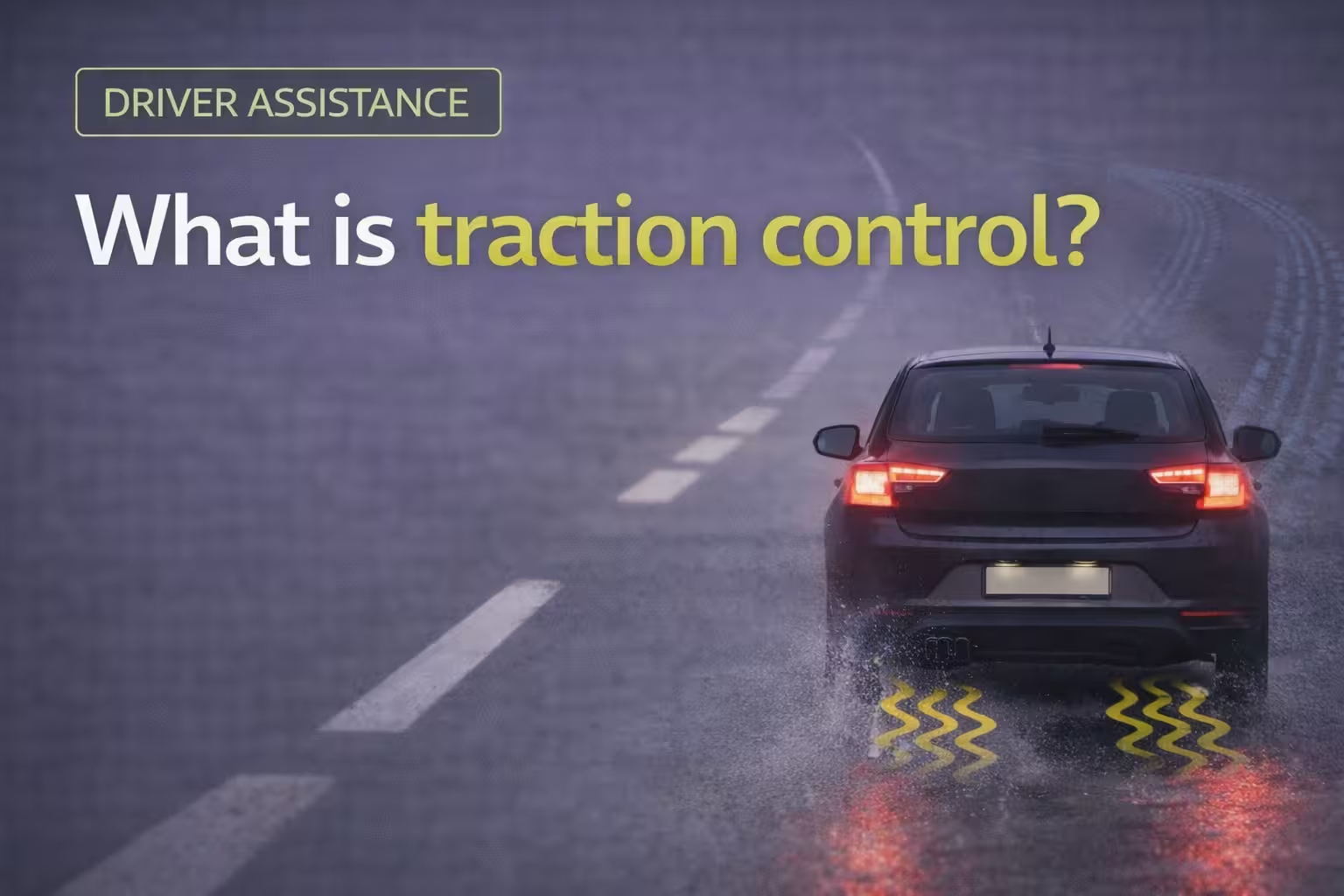
Traction control is one of those features most drivers rely on without ever thinking about it. It works silently in the background every time you accelerate on a slippery surface, correcting wheel spin before it becomes a problem. Understanding what it actually does — and what it doesn't do — helps you drive more confidently in conditions where grip is limited, and helps you get more from the car you drive.
What is traction control?
Traction control is an electronic safety system that prevents the driven wheels from spinning faster than the road surface allows. When you accelerate, the engine sends power to the driven wheels. If that power exceeds the available grip — because the road is wet, icy, loose, or the acceleration is too aggressive — the wheel spins without moving the car forward effectively. Traction control detects this and intervenes to restore grip.
The result is that the car accelerates more smoothly and with greater stability in low-grip conditions than it would without the system. On a wet roundabout, a greasy junction, or a frosty morning, traction control is working even when you don't notice it — making tiny corrections that prevent the subtle wheel spin that would otherwise cause the car to squirm or pull to one side.
How does traction control work?
Traction control uses the same wheel speed sensors as the anti-lock braking system (ABS). Each wheel has a sensor that reports its rotational speed to the car's electronic control unit (ECU) many times per second. When the driven wheel spins faster than the non-driven wheels — indicating slip rather than forward progress — the ECU detects the discrepancy and intervenes.
The intervention takes one of two forms, or a combination of both, depending on the system and the severity of the slip:
Reducing engine power. The ECU reduces the throttle, cuts ignition, or both — lowering the power being delivered to the spinning wheel until it regains traction. This is the gentler intervention and the one most drivers will occasionally notice as a slight hesitation or burble under hard acceleration.
Applying the brake to the spinning wheel. On cars with electronic brake-force distribution (which is almost all modern cars), the traction control system can apply the brake to the spinning wheel independently. By slowing the spinning wheel, the differential is forced to redirect torque to the other driven wheel, which still has grip. This is particularly useful on cars with open differentials — where without traction control, all power would simply be delivered to the wheel with the least grip.
Modern traction control systems respond within milliseconds and intervene so subtly that many drivers never consciously feel them operating. The system is constantly active when the car is in motion, not just in obviously adverse conditions.
Is traction control the same as stability control?
They're related but not the same, and understanding the difference is useful.
Traction control specifically addresses wheel spin under acceleration — the situation where a driven wheel spins faster than the road surface allows. It only operates on the driven wheels and only when power is being applied.
Electronic stability control (ESC, also called Electronic Stability Programme or ESP) is a broader system that also uses wheel speed sensors but addresses a wider range of instability. ESC can detect when the car is understeering (not turning enough — the front pushes wide) or oversteering (turning too much — the rear steps out), and intervenes by selectively braking individual wheels to bring the car back in line. ESC can operate under braking, cornering, or any combination of driving inputs, not just during acceleration.
Traction control is, in effect, a subset of stability control. On most cars built since around 2010, both systems are fitted and operate together under the stability control umbrella. In the UK, ESC has been a mandatory requirement on all new cars since 2014.
How traction control detects and corrects wheel spin
What happens in milliseconds when a wheel spins
1
Wheel speed sensors detect a difference
The driven wheel spins faster than the others, indicating slip rather than forward progress. The ECU receives this signal many times per second.
2
ECU calculates intervention type
Depending on the severity of slip, the ECU decides whether to reduce engine power, apply braking to the spinning wheel, or both simultaneously.
3
Power is cut or wheel is braked
Engine throttle is reduced, ignition may be briefly cut, or the brake is applied to the spinning wheel independently — redirecting torque to the wheel with grip.
4
Grip is restored, system stands down
Wheel speeds equalise, the spinning wheel regains traction, and the system returns to standby — often within a fraction of a second.
Traction control (TC)
Acceleration only
Prevents driven wheel spin under acceleration
Only operates when power is being applied
Reduces throttle or brakes spinning wheel
Uses same wheel speed sensors as ABS
Standard on most UK cars from ~2000
Stability control (ESC / ESP)
Acceleration, braking and cornering
Addresses understeer and oversteer too
Operates in any driving situation
Selectively brakes individual wheels
Includes traction control as a subset
Mandatory on all new UK cars since 2014
What's the traction control warning light?
The traction control light on your dashboard — typically a car with wavy lines underneath, sometimes labelled TC, TCS, or ASR — can illuminate in two different ways with different meanings.
Flashing briefly during driving is normal and indicates the system is actively working. If you accelerate on a wet or slippery surface and the light flashes momentarily, that means traction control detected and corrected wheel spin. This is the system operating as intended and requires no action.
Staying on continuously indicates either that traction control has been manually switched off, or that there is a fault with the system that requires attention. A permanently lit traction control light combined with a warning message or another warning light (such as the ABS light) should be investigated — a fault in the wheel speed sensors affects both traction control and ABS simultaneously, which is a safety concern worth having checked promptly.
On some cars, a separate indicator light appears when traction control is switched off manually — this is just confirming the driver's choice and disappears when it's switched back on.
When does traction control operate?
Traction control operates whenever a driven wheel spins faster than the road surface allows. In practical terms, this means it's most commonly active in the following situations:
Pulling away on wet, icy, or greasy surfaces. This is the most common scenario in UK conditions. Standing water, light ice, diesel spillage, or freshly fallen leaves on a roundabout can all reduce traction enough for the system to intervene on even gentle acceleration.
Hard acceleration in the dry. On powerful rear-wheel-drive cars, or any car with a performance engine, aggressive acceleration from lower speeds can overwhelm the available traction even on dry tarmac. Traction control prevents wheelspin and torque steer and keeps the acceleration linear.
Acceleration uphill on loose or muddy surfaces. Rural driveways, field access, campsites — anywhere grip is reduced, the system helps manage the available traction.
After heavy braking. When wheels have been briefly locked or near-locked under heavy braking, the tyres may be temporarily less grippy. Traction control helps manage the transition from braking to acceleration in these moments.
Can you turn traction control off?
Yes, on most cars. There is usually a button marked TC, TCS, ASR, or with the traction control icon that temporarily disables the system. On some cars, holding the button disables both traction control and stability control; a short press disables only traction control. The handbook will confirm what your specific car's button controls.
There are legitimate reasons to turn traction control off in specific situations.
Driving on deep snow or mud. In these conditions, some wheel spin is actually useful — it allows the tyre to dig through loose material to reach firmer ground underneath. Traction control can prevent this digging action by cutting power or braking the wheel, which in deep snow can actually cause the car to become stuck. Many modern cars have a specific snow mode that adjusts traction control calibration for this purpose rather than requiring a full switch-off.
Rocking a stuck car. If you're stuck in mud or snow and need to rock the car forward and back to build momentum, traction control can interrupt the motion. Switching it off allows this technique to work.
Track driving. Performance drivers on track often disable traction control because the system's intervention — which prioritises stability over outright forward progress — conflicts with the techniques used in high-performance driving. This is fine in a controlled environment with skilled drivers; it is not appropriate on public roads.
For normal everyday driving in any condition, traction control should remain on. It does not reduce performance in dry conditions — on most modern cars, traction control intervention is so fast and precise that it has no meaningful effect on dry-road acceleration.
Reading the traction control warning light
Flashing briefly while driving
The system is actively working. You've accelerated on a low-grip surface and traction control corrected a wheel spin. This is normal — no action needed.
System working normallyStaying on continuously
Either manually switched off by the driver, or a fault is present. If combined with an ABS warning light or a message, have it checked — wheel speed sensor faults affect both systems.
Check handbook / investigate faultWhen switching traction control off is (and isn't) appropriate
Deep snow or mud
Wheel spin helps tyres dig through loose material. TC can prevent this and make you more stuck. Use Snow mode if available instead of full switch-off.
Switch off: OK
Rocking a stuck car
TC interrupts the forward-back momentum rocking technique. Switching off allows the method to work.
Switch off: OK
Track driving
Performance drivers disable TC because it can interfere with advanced techniques. Only appropriate in a controlled environment with a skilled driver.
Track only
Wet roads, ice, or everyday driving
Traction control should always remain on. It doesn't reduce performance in normal driving — it only intervenes when there's a genuine problem.
Leave on
Does traction control affect fuel economy?
Not in any meaningful way during normal driving. Traction control only intervenes when wheel slip is detected, and its interventions are brief and targeted. On dry roads in everyday driving, the system is rarely active. The marginal fuel impact of occasional interventions on wet roads is negligible over a tank of fuel.
Traction control and tyres
Traction control works within the limits of your tyres — it cannot create grip that isn't there. A car with worn tyres, or tyres significantly below the recommended pressure, will have less available grip regardless of how good the traction control system is. The system can only manage the grip that exists; it cannot manufacture more.
This is worth understanding specifically in winter conditions. A set of winter tyres on a car with standard traction control will outperform a set of worn summer tyres on a car with any electronic system in cold, wet, or icy conditions. Traction control and stability control are not a substitute for tyres in appropriate condition and of appropriate type for the conditions.
Traction control and your tyres
Traction control can't create grip that isn't there
The system works within the limits of your tyres. Worn, underinflated, or incorrect tyres reduce available grip regardless of how sophisticated your traction control is. Winter tyres on a standard car will outperform summer tyres on a car with the best electronic systems in cold and icy conditions. Electronics are not a substitute for appropriate tyres.
When was traction control fitted to UK cars?
Pre-2000
Option on performance and premium models only. Not standard. Many mainstream cars had no traction control at all.
2000–2004
Increasingly standard on mid-range and above. Entry-level models still often without. Check the specific car's specification.
2004–2014
Standard on virtually all new cars. Stability control (ESC/ESP) widely available. Verify by trim level on older used examples.
2014 onwards
ESC (which includes traction control) legally required on all new cars sold in the UK. Any car first registered from Nov 2014 has it as standard.
Full spec details on every car
Browse used cars at Carsa — safety tech clearly listed
Every Carsa used car displays full specification details online including safety and driver assistance features. All cars are comprehensively inspected before sale and covered by a 90-day warranty. Finance from 8.9% APR (10.9% representative APR).
✓ Full spec shown online ✓ 90-day warranty ✓ £700 below market average ✓ Finance from 8.9% APR
Is traction control fitted to all cars?
Almost all cars sold in the UK since around 2000 have traction control as standard, and since 2004 it has been standard equipment on virtually every new car sold. Electronic stability control, which incorporates traction control, has been a legal requirement on all new cars sold in the EU and UK since November 2014.
On used cars from before 2000, traction control may not be fitted — it was an option on performance cars and some premium models but not standard equipment. For cars from 2000 to 2014, the presence of traction control depends on the specific model and trim level. From 2015 onwards, any car sold new in the UK will have both traction control and ESC as standard.
Find a well-equipped used car at Carsa
All our used cars display full specification details online, including safety and driver assistance technology. Carsa stocks a wide range of used cars priced on average £700 below market value, comprehensively inspected before sale, and covered by a 90-day warranty as standard. Finance is available from 8.9% APR representative.
Related articles


Ready to find your next car?
Browse hundreds of expertly prepared used cars — all fully checked, cleaned, and ready to drive away.
Talk to us, anytime.
Our friendly team is just a message or call away.
Message us on whatsapp, 24/7