
Are Chinese car brands worth buying in the UK in 2026? BYD, MG, and OMODA reviewed
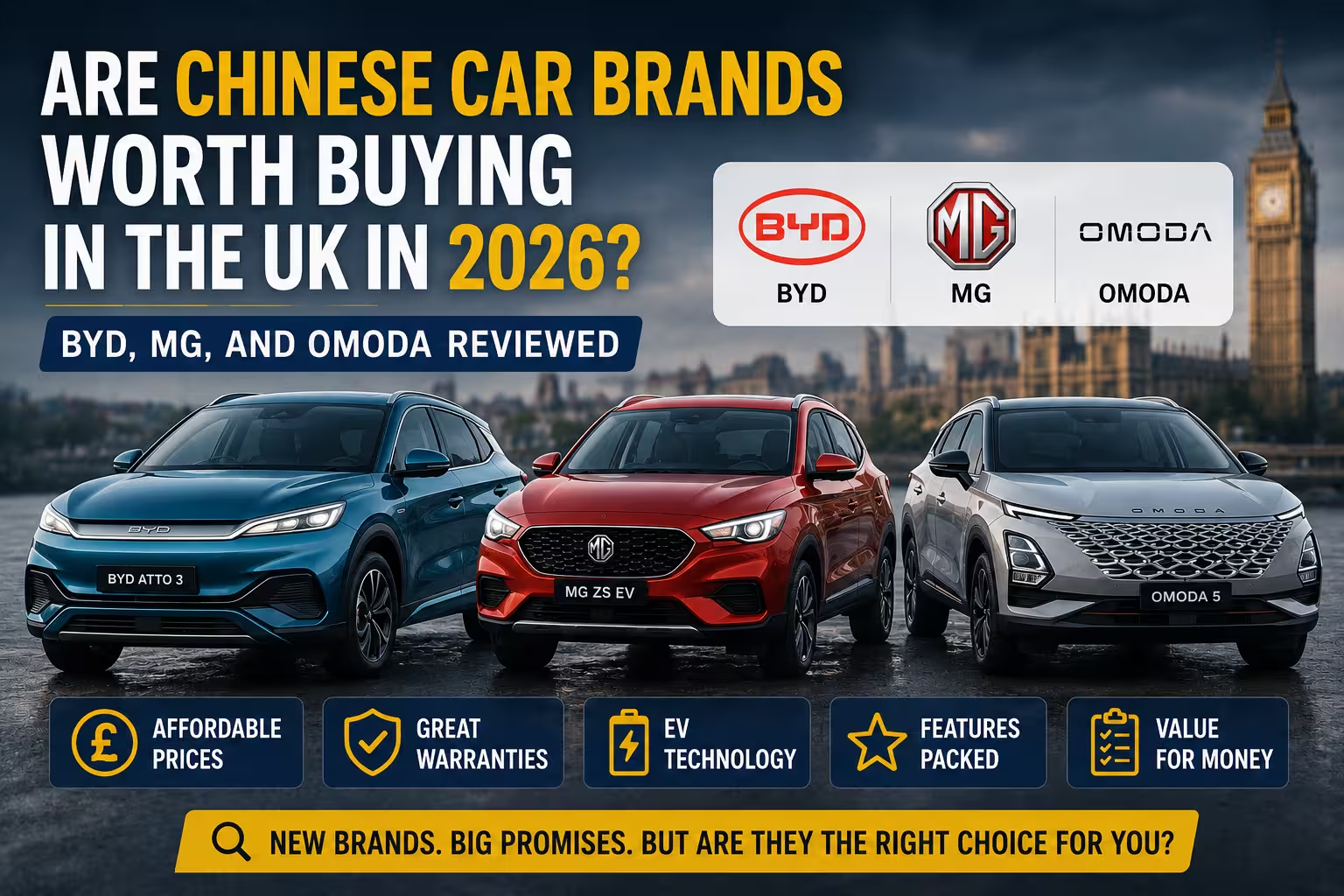
Chinese car brands accounted for more than 10% of all new vehicle registrations in the UK in the first quarter of 2026 — a milestone that would have seemed implausible to most car buyers as recently as 2023. BYD, MG, OMODA, Jaecoo, and others are no longer fringe options. They are showing up in dealer forecourts, on the school run, and in the UK best-seller charts. The Jaecoo 7 was the third best-selling new car in the UK in Q1 2026, behind only the Ford Puma and Kia Sportage. BYD registered 51,422 cars in the UK in 2025, outselling Tesla. The combined Q1 2026 registrations of BYD and Chery Group (which owns OMODA, Jaecoo, and Chery itself) overtook Volkswagen — historically the UK’s dominant single brand.
This isn’t simply a brand-awareness story. The cars are genuinely good, the pricing is genuinely competitive, and the warranties are genuinely better than most established brands offer. But there are real considerations — dealer network depth, parts availability, residual values, and longer-term reliability evidence — that prospective buyers should weigh up honestly before committing.
This guide gives an honest assessment of where Chinese brands stand in the UK in 2026, brand by brand, on the criteria that actually matter to buyers.
The state of the Chinese car market in the UK in 2026
Three groups now dominate the Chinese presence in the UK. SAIC Motor owns MG — which is, technically, a Chinese-owned brand with British heritage, having been a UK marque since 1924 before SAIC acquired it in 2007. BYD (Build Your Dreams) is an independent Chinese manufacturer and the world’s largest producer of battery-electric vehicles. Chery entered the UK only in 2024 but has scaled with extraordinary speed through its OMODA and Jaecoo sub-brands, plus the Chery brand itself.
Beyond these three, GWM (Great Wall Motor), Leapmotor, Xpeng, Geely, Changan, and Skywell are all selling cars in the UK in 2026, with varying degrees of success. Polestar and Lotus, although Chinese-owned (by Geely), are positioned as premium European brands and are usually considered separately.
The growth rates are unprecedented. BYD’s UK market share rose from 1.6% in Q1 2025 to 3.47% in Q1 2026 — a 124% year-on-year increase. OMODA’s share more than doubled in the same period. Jaecoo rose from 32nd to 17th best-selling brand in Britain, with sales up 485%. In the first four months of 2026, the UK new car market grew by 63,268 units — over 53,000 of those came from just four Chinese brands: BYD, Jaecoo, OMODA, and Chery.
MG: the most established Chinese brand on the UK market
MG is the easiest brand to recommend because it has done the longest groundwork. SAIC has been selling MG cars in the UK since 2011, and the network now extends to over 150 UK dealerships — broader coverage than several mainstream brands including Mazda and Honda.
The MG4 EV has been the standout product. Built on a dedicated EV platform with rear-wheel drive and a competitive 64kWh battery option, it offers a real-world range of 240–260 miles and 150kW peak charging, at a used price point that consistently undercuts equivalent VW, Hyundai, and Kia EVs by £2,000–£5,000. The MG ZS — available as both a petrol SUV and an electric crossover — is similarly competitive in the busy small SUV segment, and the MG HS PHEV offers a credible plug-in hybrid alternative to the Toyota RAV4 or Ford Kuga PHEV at a notably lower price.
Warranty: seven years or 80,000 miles, transferable to subsequent owners. This is among the strongest in the industry — most European and Japanese brands offer 3–5 years.
Build quality: reviewers consistently rate MG’s interior quality as well-judged for the price point. Not premium, but coherent, well-equipped, and durable in practice. Reliability records over the past five years have been broadly average for the segment — fewer than reports of significant issues but some software glitches that early cars exhibited have been largely resolved through over-the-air updates.
Dealer network: the strongest of any Chinese brand. Servicing and parts availability is comparable to mainstream brands.
Residual values: the most mature of any Chinese brand on the used market. MG4 and MG ZS depreciation curves are now well-established, and used examples trade at predictable prices.
At Carsa, current MG stock includes the MG4 EV (from around £11,000), MG ZS (petrol from around £9,700, electric from £8,600), MG HS PHEV (from around £11,000), MG5 EV estate (from around £8,400), and the small Mg3 hybrid (from around £8,100). Across all models, Carsa stocks dozens of MG variants — the depth of stock is comparable to mainstream Japanese brands.
BYD: the world’s largest EV maker arrives in force
BYD is the most discussed Chinese brand in the UK in 2026, and for good reason. It is the world’s largest producer of battery-electric vehicles — larger than Tesla — and has scaled in the UK with extraordinary speed. Its UK dealer network expanded from a handful of outlets in 2023 to over 100 dealerships by mid-2026, and the brand has invested in high-profile sponsorships (including the 2024 European Football Championships) to build awareness.
Three BYD models dominate UK sales. The BYD Atto 3 is a family-sized compact SUV competing with the Volkswagen ID.4 and Kia EV6, offering around 260 miles of real-world range. The BYD Dolphin is a Volkswagen ID.3-sized hatchback with around 200–260 miles depending on variant. The BYD Seal U plug-in hybrid SUV combines a meaningful electric range with petrol backup and has been a strong seller in 2026. The flagship BYD Sealion 7 is a Tesla Model Y rival with around 300 miles of range.
Warranty: seven years or 100,000 miles on the vehicle; eight years or 125,000 miles on the battery. These are among the most generous warranty terms available in the UK new car market in 2026.
Build quality: reviewers consistently note that BYD’s interior quality is genuinely competitive with European premium brands. The use of vegan leather, large central touchscreens (some of which rotate between portrait and landscape orientation), and comprehensive standard equipment levels exceed expectations at the price point.
Battery technology: BYD’s Blade Battery is one of the genuine technological differentiators in the market. It uses lithium iron phosphate (LFP) chemistry, which is less energy-dense than the nickel-manganese-cobalt (NMC) batteries used in most Tesla and European EVs, but is significantly more thermally stable. BYD’s public safety tests of the Blade Battery — including a controversial nail-penetration demonstration — have raised confidence in the technology. LFP batteries also degrade more slowly over time and can be charged to 100% routinely without accelerated degradation, unlike NMC batteries which manufacturers typically recommend charging to 80% for daily use.
Safety: the BYD Seal and BYD Atto 3 have both achieved five-star Euro NCAP ratings.
Dealer network: growing rapidly but not yet as deep as MG. UK coverage is now broadly comparable to brands like Subaru or Genesis.
Residual values: the genuine concern with BYD is that the brand is still establishing depreciation patterns in the UK. Early data suggests residuals are softer than mainstream Japanese or European equivalents, though this is partially offset by the lower initial purchase price.
At Carsa, current BYD stock includes the BYD Dolphin (from around £17,000), BYD Atto 3 (from around £17,200), BYD Seal U PHEV (from around £25,500), and BYD Sealion 7 (from around £38,800).
OMODA and Jaecoo: the Chery Group challengers
OMODA and Jaecoo are sub-brands of Chery, the Chinese manufacturer that entered the UK in early 2025. Both have grown faster than any new brand entry in modern UK automotive history. OMODA is positioned for younger, urban buyers; Jaecoo is positioned slightly more upmarket with rugged SUV styling. The OMODA E5 was the UK’s best-selling salary sacrifice car in 2025, finishing ahead of the Tesla Model Y — a result that few industry observers would have predicted twelve months earlier.
The OMODA 5 is a compact SUV available as a petrol or fully electric (E5) model, competing with the Nissan Juke and Ford Puma. The OMODA 9 is a larger plug-in hybrid SUV competing with the Hyundai Tucson PHEV and Toyota RAV4 PHEV. The Jaecoo 7 is a mid-size SUV that was the third best-selling new car in the UK in Q1 2026 — a position that shocked the industry given the brand was effectively unknown in the UK twelve months earlier.
Warranty: seven years coverage, transferable to subsequent owners. Identical terms across the Chery Group brands.
Build quality: reviewers have been broadly positive, with interior quality often praised for the price point. The infotainment systems are large and well-equipped, though some reviewers note that the user interface design lags behind the best European or Korean equivalents in intuitive operation.
Dealer network: the youngest of the major Chinese brands on the UK market. OMODA and Jaecoo dealerships expanded rapidly through 2025 and 2026, but the network is still considerably smaller than MG’s. Servicing coverage will be a more genuine consideration for buyers in rural areas.
Residual values: the least established — these brands have been selling in volume in the UK for less than two years, so the used market for Chery Group vehicles is still developing. This is worth factoring into purchase decisions, particularly for buyers who might trade in within 2–3 years.
At Carsa, current Chery Group stock includes the OMODA 9 PHEV (from around £36,000) and the Jaecoo 7 PHEV (from around £27,000). Both reflect the higher-spec end of the range.
What about the rest?
GWM (Great Wall Motor) sells the Ora and Wey models in the UK. Volumes are modest but growing. Leapmotor entered the UK in 2024 in partnership with Stellantis, giving it access to a substantial dealer and servicing network through Vauxhall. Xpeng arrived in 2025 with the G6 SUV, which features 354 miles of WLTP range and the fastest DC charging (280kW) of any Chinese EV currently on UK sale. Geely operates primarily through its premium brands (Polestar, Lotus, Volvo). Smart, although technically Mercedes-affiliated, is now majority Geely-owned and sells the Smart #1 and #3 in the UK.
These brands are worth knowing about but are more difficult to recommend confidently at present, primarily because dealer networks remain thin and used market data is too limited to draw firm conclusions about residual values or long-term ownership costs.
The honest considerations before buying Chinese
Three genuine concerns are worth weighing up before purchasing a Chinese-brand car.
Servicing and parts availability outside major urban areas. While MG’s network is broadly comparable to mainstream brands, BYD, OMODA, and Jaecoo have thinner coverage in rural areas. If you live in a part of the UK where the nearest dealer might be 50+ miles away, this is a practical consideration — dealer-only service and warranty work can be inconvenient. Carsa’s 90-day warranty period covers a useful initial window after purchase, but for the rest of the manufacturer warranty, dealer access matters.
Residual values are still settling. Used Chinese-brand cars have been on the UK market in meaningful volume for only 2–4 years. The depreciation curves are still being established and are not as predictable as for established brands. Brands with the longest UK history (MG) have the most predictable residuals. The newest entrants (Jaecoo, BYD beyond the early Atto 3) have residual values that may move significantly as the market matures.
Long-term reliability data is still emerging. Initial reliability surveys (Driver Power, Honest John, Which?) have generally been positive on Chinese brands, but the cars haven’t been on UK roads long enough to assess 8–10 year reliability. Early reports are encouraging, particularly on EVs where the simpler mechanical architecture reduces failure modes, but buyers committing to long ownership should be aware that the long-term track record is still being written.
The genuine advantages
Set against those considerations are three meaningful advantages.
Pricing. Chinese brands are typically 10–20% cheaper than equivalent mainstream brands for similar specification. This advantage has only widened with the Middle East conflict’s impact on supply chains across the European market in 2026 — Chinese manufacturers have absorbed cost pressures more readily than European equivalents.
Warranty. Seven-year warranties as standard across the major Chinese brands match or exceed Kia’s industry-leading seven-year cover, and significantly exceed the three to five years offered by Volkswagen Group, Stellantis, Ford, Renault, BMW Group, and Mercedes-Benz. For used buyers, this often means meaningful remaining warranty cover on a 2–3 year old car — a tangible advantage that translates directly into peace of mind.
Technology and equipment. Standard equipment levels on Chinese-brand cars consistently exceed equivalent European or Japanese rivals. Large touchscreens, comprehensive driver assistance, premium-feeling materials, and competitive standard active safety equipment are the norm. Five-star Euro NCAP ratings on the BYD Seal, BYD Atto 3, MG4, and Xpeng G6 confirm that safety standards meet European expectations.
Which Chinese brand is right for you?
For buyers prioritising network coverage and the most established UK track record, MG is the strongest recommendation. For buyers prioritising battery technology, EV range, and the highest standards of interior quality at the price point, BYD is the most compelling choice. For buyers prioritising specific body styles or buying a hybrid SUV at competitive pricing, OMODA and Jaecoo are credible options.
For nervous first-time buyers in a brand, MG offers the lowest-risk entry point. For confident buyers willing to accept slightly thinner network coverage in exchange for what is genuinely impressive engineering, BYD’s case is now strong enough that the discount versus comparable Tesla or Hyundai EVs is hard to ignore.
Browse Chinese-brand used cars at Carsa
Carsa stocks a wide range of used MG, BYD, OMODA, and Jaecoo vehicles, all priced on average £700 below market value, with a 90-day warranty included and the option to reserve online for collection at your nearest Carsa store. Every car is inspected and prepared before sale. Finance is available from 10.9% APR representative. Carsa is a credit broker, not a lender. The rate you are offered will depend on your individual circumstances.
Related articles



Ready to find your next car?
Browse hundreds of expertly prepared used cars — all fully checked, cleaned, and ready to drive away.
Talk to us, anytime.
Our friendly team is just a message or call away.
Message us on whatsapp, 24/7