
How cars can be adapted for disabled drivers and passengers
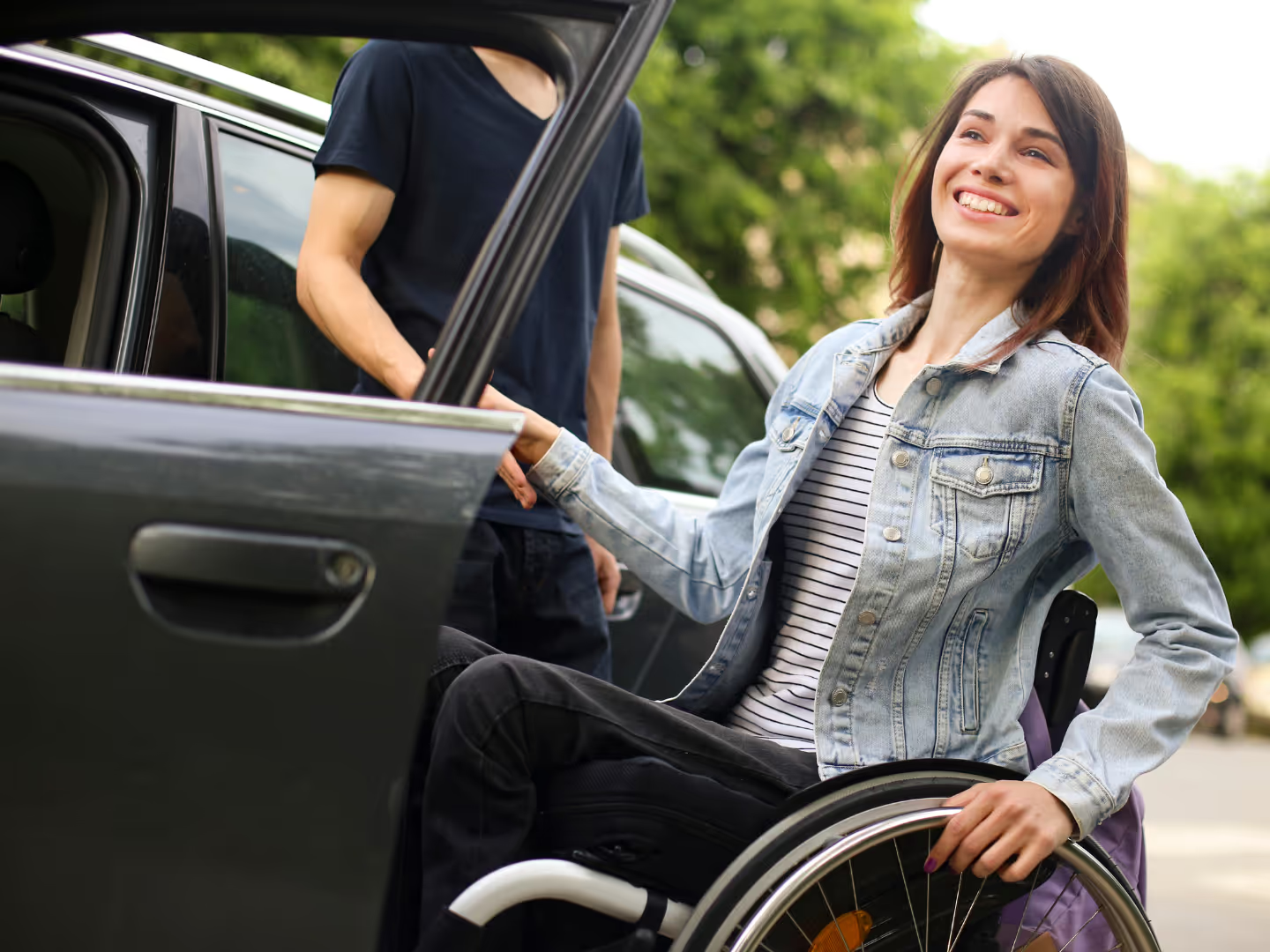
Driving or travelling independently makes an enormous difference to quality of life, and modern vehicle adaptations mean that disability or reduced mobility is rarely the barrier it once was. Whether you're a driver looking to get behind the wheel for the first time with a new diagnosis, a passenger who needs better access, or a family buying a car to accommodate a wheelchair user, the range of options available in the UK today is wider and more accessible than most people realise.
This guide covers the main types of adaptation, the professional assessment process, funding options including Motability, and what to consider when buying a used car.
Start with a professional driving assessment
Before modifying any vehicle or purchasing adaptive equipment, a professional driving assessment is the right starting point for anyone whose disability affects their ability to drive. Driving Mobility is the national network of independent driving assessment centres across the UK. Their assessors — typically a Driving Rehabilitation Specialist and an Approved Driving Instructor — evaluate your current abilities behind the wheel and recommend specific adaptations that would allow you to drive safely and legally.
An assessment from a Driving Mobility centre covers physical capability, reaction times, and the specific vehicle modifications that would suit your needs. The recommendations carry weight with adaptation specialists, insurance providers, and the DVLA. Assessments typically cost between £150 and £250 depending on the centre and complexity of assessment.
For passengers rather than drivers, an Occupational Therapist (OT) specialising in mobility can advise on appropriate access solutions and restraint systems without the driver assessment element.
Hand controls
Hand controls replace the function of foot pedals, allowing drivers who have limited or no use of their legs to accelerate and brake using a lever or push-pull mechanism attached to the steering column. They come in several configurations — push-pull (where pushing operates the brake and pulling operates the accelerator), push-right-angle, and push-rock, among others. The right configuration depends on your specific upper limb strength and grip.
Hand controls must be professionally fitted by a qualified adaptation specialist. They are designed to work alongside the standard pedals, which remain in place, meaning another driver can use the car without removing anything. Most major manufacturers — including Renault, Vauxhall, Ford, and Volkswagen Group — offer factory-fit hand controls as an option on new cars; on used cars, specialist aftermarket fitting is the standard route.
Steering adaptations
For drivers with limited hand or arm strength, a range of steering adaptations can make control easier and safer. Steering wheel knobs (sometimes called spinner knobs) clamp onto the wheel and allow single-handed steering with significantly less effort. Tri-pin and quad-pin grips are designed for drivers with limited finger function. Joystick steering and reduced-effort power steering systems are available for drivers with more significant upper limb impairment, though these require specialist installation and DVLA notification.
Reduced-effort steering modifications work with the car's existing power steering system and can significantly lower the force needed to turn the wheel, which is particularly relevant for drivers with conditions affecting upper body strength.
Accelerator and brake modifications
Left-foot accelerator pedals allow drivers who cannot use their right foot to operate the accelerator with their left, with a blanking plate fitted over the standard right-foot pedal to prevent accidental operation. These are professionally fitted and DVLA notifiable.
Extended or relocated pedals can bring the controls closer or reposition them to a more accessible angle. Pedal guards prevent accidental contact with the wrong pedal and are a relatively simple, low-cost adaptation.
Swivel seats and transfer aids
Getting in and out of a car is often the biggest practical challenge for drivers and passengers with hip, knee, or spinal conditions. Swivel seats rotate outward through the door opening, reducing the degree of bend required at the hip and allowing a more controlled transfer. They're available as manual swivel mechanisms (rotated by hand) or powered (operated by a button), and can be fitted to most standard car seats.
Transfer boards bridge the gap between a wheelchair and the car seat, allowing a lateral slide transfer. Grab handles and transfer belts help support the person during the transfer. For those who need maximum support, hoist systems — including portable lifts that stow in the boot — can manage a full hoist transfer from a wheelchair.
Wheelchair access: ramps and lifts
For drivers or passengers who remain in their wheelchair while travelling, the vehicle itself needs to be modified to allow access and appropriate restraint.
Wheelchair-accessible vehicles (WAVs) can be either purpose-built or converted from standard vans and people-carriers. The conversion typically involves a lowered floor to increase internal height, a rear- or side-entry ramp or lift, and wheelchair tie-down and occupant restraint systems (WTORS) to the appropriate British Standard. The Volkswagen Caddy, Peugeot Partner, Ford Tourneo Connect, and various Fiat models are commonly used as the base for WAV conversions in the UK.
Ramps can be manual fold-out, power-operated fold, or retractable. Lifts (platform lifts and scissor lifts) are more complex and typically fitted in larger vehicles; they provide a powered platform that lowers to ground level and rises to floor height, which is useful where ramp gradient would be steep or where the passenger cannot self-propel.
Any vehicle in which a wheelchair user travels as a passenger while remaining in the chair must have a four-point tie-down system and an appropriate seatbelt or harness. This is a safety-critical requirement and must be installed and tested to British and European standards by a qualified converter.
Voice activation and technology-based adaptations
Modern cars increasingly offer voice-activated controls for navigation, audio, phone calls, and climate — built into the infotainment system through Apple CarPlay, Android Auto, or the manufacturer's own system. For drivers with limited hand function, being able to control these functions without physical interaction is a genuine safety and usability benefit.
Advanced driver assistance systems (ADAS), now standard or available on most new and recent used cars, include features that can be particularly valuable for disabled drivers. Adaptive cruise control maintains a set following distance autonomously, reducing the physical and cognitive demand of motorway driving. Lane-keeping assist and lane centring reduce the need for constant steering correction. Automatic emergency braking provides a safety layer if reaction time is affected. Parking sensors and cameras reduce the physical demands of manoeuvring.
These features aren't adaptations in the traditional sense, but they can make a meaningful difference to the manageable driving range for drivers with conditions that create fatigue or limit concentration over long periods.
DVLA notification requirements
Many vehicle adaptations require notification to the DVLA. Drivers have a legal obligation to tell the DVLA about any medical condition that could affect their ability to drive safely, and a separate obligation to notify when certain adaptations are fitted. Adaptations that are DVLA notifiable include hand controls, left-foot accelerators, steering modifications, and any modification affecting the primary driving controls.
Failure to notify the DVLA when required can invalidate your driving licence and your vehicle insurance. The DVLA's website provides guidance on which conditions and adaptations require notification, and a Driving Mobility assessment will typically clarify what reporting is required in your specific case.
Vehicle insurance with adaptations
A standard car insurance policy must be informed of all vehicle modifications, including disability adaptations. Most major insurers cover disability adaptations without a premium loading, since the adaptations are typically safety-related rather than performance modifications — but failing to disclose them can void your policy. Some specialist insurers, including Adrian Flux and Able2Drive, specifically cater to adapted vehicle insurance and may offer more competitive terms for significantly modified vehicles.
Funding your vehicle adaptation: Motability and other schemes
The cost of vehicle adaptations varies significantly — from a few hundred pounds for simple hand controls to £10,000 or more for a full wheelchair-accessible conversion. Several routes exist in the UK to help fund them.
The Motability Scheme is the best-known route to an adapted car for eligible disabled people. If you receive the Higher Rate Mobility Component of Disability Living Allowance (DLA), the Enhanced Rate Mobility Component of Personal Independence Payment (PIP), the War Pensioners' Mobility Supplement, or the Armed Forces Independence Payment at the appropriate level, you can use your mobility allowance to lease a new car through the scheme. Motability covers insurance, servicing, and breakdown cover within the lease, and has an extensive list of approved adaptations — many of which are provided at no additional cost or at a subsidised rate. Allowances for more complex adaptations and WAVs are available.
Access to Work is a government grant scheme administered by the DWP that can fund adaptations and equipment needed to get to and from work. If your disability means you need an adapted vehicle specifically for employment, Access to Work may cover some or all of the adaptation costs.
Charitable grants are available from a number of organisations for individuals who don't qualify for Motability or Access to Work. Motability Operations, Turn2us, and condition-specific charities (such as the MS Society, Spinal Injuries Association, and RNIB) can provide guidance on available funding sources.
Buying a used adapted car
A used adapted car can offer significant savings compared to a new vehicle or a new Motability lease, and many adaptations — particularly hand controls and swivel seats — are transferable between vehicles if needed.
When buying a used adapted car, check that adaptations were installed by a qualified specialist and ask for documentation confirming the standard to which any WAV conversion was completed. Verify that the DVLA has been notified of all relevant adaptations and that the V5C reflects the modified configuration. Confirm that the tie-down and restraint systems in any WAV have been maintained and inspected to the current British Standard. Have any electronic adaptations checked by a specialist before purchase.
At Carsa, our team is experienced in supporting buyers with specific requirements. If you're looking for a car suitable for adaptation, or you have questions about a specific vehicle's suitability for a particular modification, get in touch and we'll do our best to help.
Useful contacts
Driving Mobility (driving assessment centres): drivingmobility.org.uk. The Motability Scheme: motability.co.uk. DVLA medical enquiries: 0300 790 6806. Access to Work: gov.uk/access-to-work. British Healthcare Trades Association (BHTA) — lists accredited adaptation specialists: bhta.com.
Find your next car at Carsa
Carsa stocks a wide range of used cars priced on average £700 below market value, all comprehensively inspected before sale with a 90-day warranty as standard. Finance is available from 8.9% APR (10.9% APR representative).
Related articles


Ready to find your next car?
Browse hundreds of expertly prepared used cars — all fully checked, cleaned, and ready to drive away.
Talk to us, anytime.
Our friendly team is just a message or call away.
Message us on whatsapp, 24/7