
Most Fuel Efficient Cars in 2026: And How to Reduce Your Fuel Costs
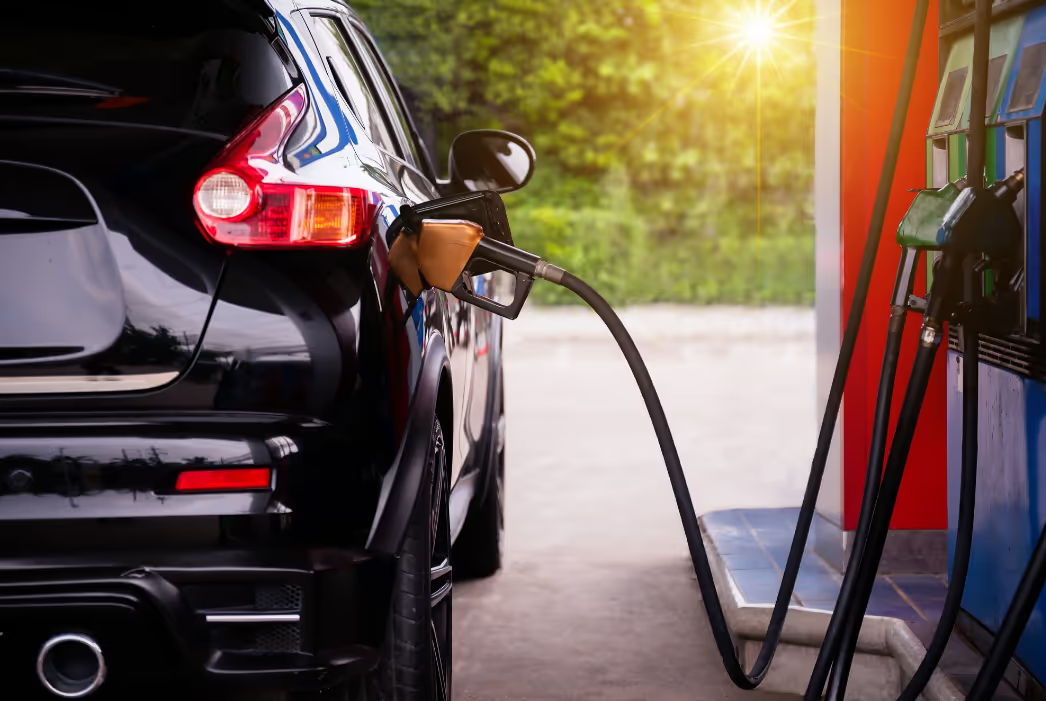
Fuel prices in the UK have remained volatile through 2024 and into 2026, and running costs are front of mind for most used car buyers. The good news is that the used market has never offered better fuel efficiency across the board — from genuinely impressive petrols, to self-charging hybrids cutting 30–40% off your fuel bills, to electric cars with no fuel costs at all. Here's a practical guide to the most fuel efficient used cars available in 2026, and the driving habits that make the biggest difference to what you spend at the pump.
What does fuel efficiency actually mean?
Fuel efficiency is measured in miles per gallon (mpg) for petrol and diesel cars, and miles per kWh for electric vehicles. The official figures you see on a listing are tested under controlled conditions — real-world mpg is typically 10–15% lower, depending on driving style, road type, and conditions. For hybrids, the gap between official and real-world figures is usually smaller because their efficiency advantage is most pronounced in exactly the kind of stop-start urban driving that official tests replicate.
For electric cars, efficiency is measured in miles per kWh. A car that uses 3.5 miles per kWh from a 60kWh battery has a theoretical range of around 210 miles — though real-world range varies with temperature, speed, and heating or air conditioning use.
Most fuel efficient petrol and hybrid cars in 2026
Toyota Yaris Hybrid
The Toyota Yaris Hybrid is one of the most fuel efficient small cars you can buy used in 2026. Real-world fuel economy of 55–65mpg is achievable in everyday driving, particularly in urban conditions where the electric motor does more of the work. Toyota's full hybrid system is self-charging — no plugging in required — and the brand's reliability record means these cars hold up extremely well over high mileage. The third-generation Yaris (from 2020) is the best used buy, with the fourth-generation now arriving in the used market too.
Toyota Corolla Hybrid
The Corolla Hybrid is a larger step up from the Yaris, available as hatchback and Touring Sports estate. Real-world fuel economy of 48–58mpg is consistently achievable. The Touring Sports estate is particularly popular with families wanting efficiency and practicality. The 2.0-litre hybrid system added to the range from 2019 offers stronger performance alongside similar economy. Like all Toyota hybrids, service history is important — but the fundamental reliability is exceptional.
Toyota RAV4 Hybrid
For buyers wanting an SUV without sacrificing running costs, the RAV4 Hybrid is one of the best used purchases in its class. Real-world economy of 40–48mpg for a car this size is genuinely impressive, and the self-charging hybrid system means no dependency on charging infrastructure. The RAV4 Plug-in Hybrid (PHEV, from 2020) extends electric-only range to around 46 miles — ideal if you have home charging and a shorter daily commute.
Honda Jazz Hybrid
The fourth-generation Jazz (from 2020) uses Honda's e:HEV twin-motor hybrid system, which is effectively a series hybrid — the petrol engine primarily acts as a generator rather than driving the wheels directly in most conditions. The result is real-world fuel economy of 50–60mpg, particularly impressive given the Jazz's practical interior. It's an excellent choice for urban drivers who want efficiency without the hassle of charging.
Hyundai Ioniq Hybrid and PHEV
The original Hyundai Ioniq (2016–2022) was one of the most aerodynamically efficient cars ever produced and earned consistently strong real-world fuel economy figures. The hybrid version returns 55–65mpg in mixed driving. The PHEV version adds around 38 miles of electric range on a charge. Both have now settled into the affordable used bracket and represent good value. The newer Ioniq 6 (all-electric) and Ioniq 5 have largely replaced the range, but the original Ioniq remains an underrated used efficiency buy.
Kia Niro Hybrid and PHEV
The Kia Niro has always been one of the most practical efficient cars available — it's SUV-shaped, decently spacious, and returns real-world fuel economy of 48–58mpg in hybrid form. The PHEV version (first-generation from 2016; second-generation from 2022) offers around 40 miles of pure electric range. Kia's seven-year warranty transfers to subsequent owners on eligible models, which makes used examples particularly reassuring to buy.
Electric cars: zero fuel costs
Electric vehicles have no fuel cost in the conventional sense — the equivalent cost per mile of home charging at average UK electricity rates is roughly 3–5p per mile, compared to 15–20p per mile for petrol. For high-mileage drivers, the running cost saving can be substantial.
The Tesla Model 3 remains one of the most energy-efficient electric cars on the used market, using around 3.8–4.2 miles per kWh — which translates to a real-world range of 220–280 miles depending on the variant and age. The Model 3 Long Range is the sweet spot for buyers who want to cover distance confidently.
The Nissan Leaf (40kWh and 62kWh variants) is the most affordable entry point into used electric motoring and is well-suited to drivers with shorter daily commutes and home charging. The 40kWh Leaf delivers a real-world range of around 130–150 miles — enough for most UK commuters. For longer range, the 62kWh Leaf e+ approaches 220 miles in real-world conditions.
The Renault Zoe remains popular in the compact EV segment, with the 52kWh version offering up to 220 miles officially. It uses a CCS charging port on newer models, which is the UK standard, making public charging straightforward.
When is fuel consumption at its highest?
Understanding when your car uses the most fuel is just as important as choosing an efficient model. These are the conditions that hurt fuel economy most:
Cold starts. A cold engine is dramatically less efficient than a warm one. In the first few minutes of a journey, fuel consumption can be two to three times higher than normal as the engine works to reach operating temperature. Short journeys — under three miles — mean the engine never reaches its efficient operating window. If you regularly do very short trips, a hybrid is particularly effective because it can run on electric power alone for those first few miles.
Stop-start urban traffic. Every time you brake to a stop, the kinetic energy your engine worked to create is lost as heat. Accelerating back up to speed consumes fresh fuel. This cycle is where fuel consumption is highest — and where hybrids, which use regenerative braking to recapture that energy, deliver their greatest advantage over conventional petrol cars.
High speed. Aerodynamic drag increases with the square of speed — so driving at 80mph doesn't use 14% more fuel than 70mph, it uses significantly more. Most cars reach peak fuel efficiency between 50 and 60mph. Above 65mph, fuel consumption climbs steeply. On motorway journeys, cruise control set at 60–65mph consistently produces better real-world economy than varying between 65 and 80mph.
Air conditioning. Running air conditioning adds roughly 5–10% to fuel consumption on most cars. At lower speeds, opening windows is more efficient. At motorway speeds, the aerodynamic drag from open windows outweighs the cost of A/C — so use it above around 50mph and open windows below it.
Overloading. Every extra 50kg in the car adds roughly 1–2% to fuel consumption. A full boot of camping gear, roof box, or tow bar load all increase running costs. Remove anything from the car you're not regularly using.
Under-inflated tyres. A tyre running 5–6psi below its recommended pressure creates meaningfully more rolling resistance. Check pressures monthly — and before any long journey. The recommended pressures are on a sticker inside the driver's door frame and in your handbook.
Practical tips to reduce fuel consumption right now
Accelerate gently and read the road ahead. The most effective fuel-saving technique for any car. Anticipate the road ahead and lift off the accelerator early when you can see you'll need to slow down. Coasting in gear uses less fuel than accelerating and then braking hard. On modern cars with fuel injection, lifting off in gear often cuts fuel flow entirely.
Use higher gears earlier. In a manual car, moving up a gear earlier (at around 2,000rpm for diesel, 2,500rpm for petrol) reduces engine RPM and fuel consumption. Many modern cars show a gear shift indicator on the dashboard — following it consistently improves economy.
Remove roof boxes and bike racks when not in use. These add significant aerodynamic drag. A roof box at motorway speed can add 10–15% to fuel consumption. Take it off when it's not needed.
Avoid very short journeys in a cold car. Combine errands into one trip so the engine is already warm. If you make lots of short urban trips, consider whether a hybrid or electric car would suit your driving pattern better than a conventional petrol.
Use eco mode. Most modern cars have an economy driving mode that softens throttle response and adjusts gearshift points for efficiency. It's worth using on longer motorway journeys and in urban traffic.
Find a fuel-efficient used car at Carsa
Carsa stocks a wide range of fuel-efficient used cars — from self-charging Toyota and Honda hybrids to plug-in hybrids and fully electric vehicles — all priced on average £700 below market value, with finance from 8.9% APR and a 90-day warranty on every car.
Browse fuel-efficient used cars at Carsa →
Related articles



Ready to find your next car?
Browse hundreds of expertly prepared used cars — all fully checked, cleaned, and ready to drive away.
Talk to us, anytime.
Our friendly team is just a message or call away.
Message us on whatsapp, 24/7