
Audi A3 vs BMW 1 Series vs Mercedes A-Class: The ultimate used premium hatchback guide
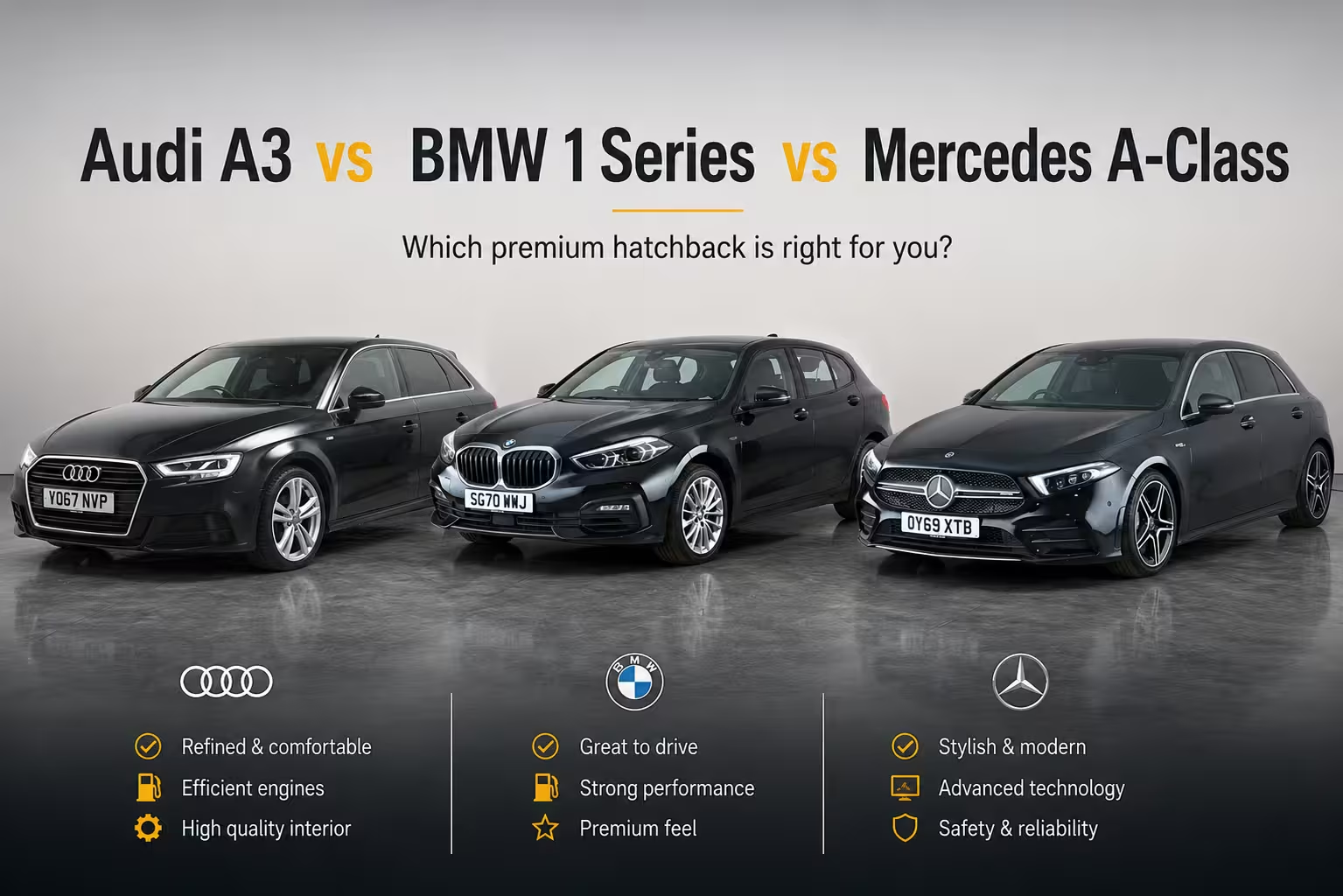
The Audi A3, BMW 1 Series, and Mercedes A-Class are the three cars that define the premium compact hatchback segment in the UK. They are the natural step up from a Polo or Golf for buyers who want German engineering and premium badge appeal at a price that still works on a finance calculator. Each makes a different case, and the choice between them depends as much on what you value as on what is objectively best.
This guide compares all three on the criteria that actually matter to used buyers in 2026 — depreciation, running costs, reliability, interior quality, finance options, and the driving experience — with real pricing from Carsa's current stock to anchor the numbers in reality.
The segment in 2026: why these three dominate
The premium compact hatchback class exists because mainstream brands could not, for a long time, justify the badge and material standards that buyers wanted at five-door hatchback prices. Audi, BMW, and Mercedes solved that problem by offering smaller versions of their luxury saloons, sharing some interior architecture, infotainment systems, and powertrains with their bigger sisters. The result is that a used A3, 1 Series, or A-Class delivers a meaningful share of the experience of an A4, 3 Series, or C-Class — at significantly lower used purchase prices.
The market for these cars has shifted in 2026. The traditional German trio remain dominant precisely because they continue to refresh their products and because used buyers value the established service network and parts availability they provide. All three are being increasingly challenged by Chinese brands like BYD and OMODA, but at the premium hatchback price point specifically, the German trio still holds the field for used buyers.
The Audi A3: the safest used choice
The Audi A3 has been the consistent best-seller in this segment for over a decade, and Carsa's stock reflects that — 64 A3s currently available, more than the 1 Series and A-Class combined. There is a reason for this consistency: the A3 is the easiest car of the three to recommend without caveats. It is fractionally less exciting to drive than the BMW and fractionally less visually distinctive than the Mercedes, but it does almost everything well, and Audi's interior quality is genuinely class-leading in the price range.
The current-generation A3 (4th generation, launched 2020) is built on the Volkswagen Group MQB Evo platform shared with the Volkswagen Golf 8 and SEAT Leon. This is not a downside — the underlying engineering is excellent — but it does mean the A3 is best understood as a more refined, better-trimmed Golf rather than as a fundamentally different car. The interior, particularly in S Line trim, justifies the premium with genuinely high-quality materials and the well-judged Audi Virtual Cockpit digital dashboard.
Engine choices on the used market span 1.0 TFSI 110hp three-cylinder petrols, 1.5 TFSI 150hp four-cylinder petrols (the sweet spot for most buyers), 2.0 TFSI 200hp+ petrols (S3 and RS3 territory), 2.0 TDI 150hp diesels, and 40 TFSI e plug-in hybrid variants. For most buyers, the 1.5 TFSI Sportback in S Line trim represents the practical pick — enough performance for any normal driving, fuel economy in the 45–50 mpg range, and the desirable interior trim.
At Carsa: 64 used A3s from £10,463 to £31,243, average price £17,844, average mileage 38,979 miles.
The BMW 1 Series: the most polarising
The BMW 1 Series has a more complicated story than the other two cars in this comparison, because it has been two fundamentally different cars across the period covered by today's used market. The pre-2019 1 Series was rear-wheel drive — the only premium hatchback with that layout — and is loved by enthusiasts for its handling, six-cylinder engine availability, and distinctive driving dynamics. The current third-generation 1 Series (F40, launched 2019) switched to front-wheel drive on a shared platform with the Mini Countryman.
This matters for used buyers in 2026 because the two versions appeal to genuinely different buyers and command different prices. A 2017–19 RWD 1 Series in M Sport trim is a niche performance buy that is becoming a future classic. A 2020+ FWD 1 Series is a more conventional premium hatchback rival to the A3 and A-Class. Be clear which version you are looking at before you commit.
The current-generation 1 Series is competitive but not class-leading. The interior quality is good but does not quite match the A3 for material consistency, and the styling — particularly the controversial larger grille — divides opinion more than the more conservative A3 or the more dramatic A-Class. What the current 1 Series does well is driving dynamics: even in front-wheel drive form, BMW chassis engineering shows through, and the car remains the most engaging of the three to drive on a twisty road.
Engine choices include the 118i 1.5-litre three-cylinder petrol (the volume seller), the 120i 2.0-litre four-cylinder, the 118d and 120d diesels, and the M135i xDrive performance variant. The 1 Series is the only car in this comparison to offer all-wheel drive on the M135i, which gives it a genuine advantage for buyers in hilly or northern UK regions.
At Carsa: 28 used 1 Series from £9,626 to £24,553, average price £17,180, average mileage 48,775 miles.
The Mercedes A-Class: the design statement
The Mercedes A-Class is the most visually distinctive of the three and was, when launched in its current W177 generation in 2018, the most technologically advanced premium hatchback on the UK market. The MBUX infotainment system, with its dual-screen layout, voice control, and "Hey Mercedes" activation, was genuinely ahead of its rivals for several years — the A3 and 1 Series have since caught up, but the A-Class remains the most tech-feature-rich of the three.
The exterior is the most dramatic in the segment. Sloping roofline, low stance, deeply sculpted body panels — the A-Class looks like a small premium car should look, where the A3 is more reserved and the 1 Series is more controversial. This is partly why the A-Class has been particularly successful with younger buyers and salary-sacrifice customers.
The trade-off is that interior space is the most compromised of the three. Rear legroom is the tightest, and the sloping roof reduces rear headroom for adult passengers compared to the A3 and 1 Series. The boot is also slightly smaller. For singles, couples, and small families with young children, this rarely matters. For families with growing teenagers or regular adult passengers in the back, it is worth a careful test.
Engine choices include the A180 1.3-litre four-cylinder petrol (entry-level), the A200 (volume seller, jointly developed with Renault-Nissan), the A220 2.0-litre, the A250e plug-in hybrid (one of the best PHEVs in the segment for genuine EV range), the diesels A180d and A200d, and the AMG A35 and A45 performance variants. For most buyers, the A200 AMG Line Premium is the sweet-spot pick.
At Carsa: 43 used A-Class from £10,332 to £27,437, average price £16,212, average mileage 47,160 miles.
Depreciation: which holds its value best?
All three cars depreciate at broadly similar rates over the first five years, but there are subtle differences worth understanding. Audi A3 residuals have been the most consistent over the past decade — the car holds value well because demand is so steady, and supply on the used market is steady rather than spiking with ex-fleet returns. This makes both buying and selling an A3 a relatively predictable transaction.
Mercedes A-Class residuals are more variable. The dramatic exterior and high-spec equipment are particularly desirable to certain buyers, but the high original list prices on top-spec variants mean the absolute pound depreciation can be steep — a £45,000 A250e new becomes a £18,000 used car within three or four years. For used buyers, this is an opportunity: well-specified A-Class examples can be the best value of the three on a pound-per-feature basis.
BMW 1 Series residuals depend significantly on which generation. The earlier rear-wheel drive cars now have stabilising residuals as they transition into modern classic territory — some special variants (M140i, M135i Mk1) are actually appreciating. The current front-wheel drive generation depreciates more conventionally and at similar rates to the A3.
Reliability: which has the fewest problems?
Driver Power, Honest John, and What Car? reliability data across the three cars over the past five years places the A3 marginally ahead of the A-Class, with the 1 Series typically third — though all three sit broadly in the middle of the industry rather than at the top or bottom.
Specific issues to watch on the Audi A3 include the early-life DSG dual-clutch transmission on certain 1.5 TFSI variants (Audi extended warranty coverage on this), occasional infotainment software glitches that are resolved by updates, and the 2.0 TDI EA189 engines from the diesel emissions scandal era which are now well outside warranty.
Specific issues to watch on the BMW 1 Series include the timing chain on the earlier 1.6 N13 petrol engine (largely irrelevant for 2017+ buyers but a key check on older cars), the Valvetronic eccentric shaft sensor on the 2.0-litre B48 engine which can fail intermittently, and electrical gremlins around the iDrive system on early F40 cars.
Specific issues to watch on the Mercedes A-Class include the MBUX infotainment system's occasional bugs (mostly resolved through updates), the 7G-DCT transmission on early W177 cars (some early cars had recalls), and rear suspension wear on cars driven hard.
All three are generally reliable when bought from a thorough specialist or franchised dealer with full service history. The key check on any premium German hatchback is service history at correct intervals — these cars are not as forgiving of skipped services as a Korean or Japanese equivalent.
Insurance and running costs
Insurance groups for all three sit broadly in the 16–40 range depending on variant. For 25+ drivers, this is generally affordable. For drivers under 25, premium hatchbacks of this class are significantly more expensive to insure than a Polo or i10 — if you are under 25 and looking at one of these cars, get insurance quotes before committing.
Fuel economy is similar across the three: real-world figures for the petrol entry-level engines sit at 45–50 mpg in mixed driving. Diesels return 55–60 mpg. The plug-in hybrid A3 40 TFSIe and A-Class A250e can achieve much better headline figures if you charge them regularly — anything from 80 mpg with regular charging to around 40 mpg without.
Servicing costs at a main dealer are similar for all three, typically £300–£500 per year on minor/major alternating schedules. Independent specialist garages can reduce this by 30–40%. Brand-specific independents are usually the best balance of cost and expertise once the cars are out of manufacturer warranty.
Interior quality and tech
The Audi A3 interior is the most consistently well-judged — high-quality plastics throughout, the most coherent design language, and an infotainment system that prioritises usability over visual flash. The MMI system is intuitive once learned, and the Virtual Cockpit display behind the steering wheel is excellent.
The Mercedes A-Class has the most visually dramatic interior with its dual-screen layout. MBUX is feature-rich and the voice control is genuinely capable. The trade-off is some of the lower-cost materials on entry-level A180 cars are visibly less premium than the A3 — the A-Class's interior shines most on AMG Line and Premium trims.
The BMW 1 Series interior is functionally excellent but the least visually distinctive of the three. iDrive remains one of the best infotainment systems in the industry, with a rotary controller that is faster to use than touchscreen-only alternatives. Some interior materials feel less premium than the A3, but the layout is logical and durable.
Which is the best to drive?
The BMW 1 Series is the best driver's car. The chassis tuning, steering feedback, and overall responsiveness exceed both the A3 and A-Class. The M135i xDrive is a genuine hot hatch with serious performance and all-wheel-drive grip.
The Audi A3 is the most relaxed and refined, particularly with the S Line suspension. The S3 is fast in a straight line but less engaging than the M135i for back-road work.
The Mercedes A-Class sits between the two in terms of dynamic character — more relaxed than the BMW, slightly less polished than the Audi at speed, but with strong ride comfort in standard trim and genuine grip with the AMG variants.
The three premium hatchbacks side by side
The three premium hatchbacks side by side
Live data from Carsa stock as of publication. Rankings reflect typical 2026 buyer expectations.
Audi
A3
The safest used choice
In stock at Carsa
64 cars Most stock
Price range
£10,463 – £31,243
Average price
£17,844
Average mileage
38,979 mi Lowest
Best variant
1.5 TFSI S Line Sportback
Interior quality
Class-leading
Driving experience
Refined, relaxed
Reliability
Best of three
Residual value
Most predictable
BMW
1 Series
The driver's choice
In stock at Carsa
28 cars
Price range
£9,626 – £24,553 Cheapest entry
Average price
£17,180
Average mileage
48,775 mi
Best variant
118i M Sport (or pre-2019 RWD)
Interior quality
Functional, durable
Driving experience
Best in class Winner
Reliability
Good, third place
Residual value
RWD models appreciating
Mercedes-Benz
A-Class
The design statement
In stock at Carsa
43 cars
Price range
£10,332 – £27,437
Average price
£16,212 Best value avg
Average mileage
47,160 mi
Best variant
A200 AMG Line Premium DCT
Interior quality
Most dramatic, MBUX
Driving experience
Comfortable, refined
Reliability
Solid mid-pack
Residual value
Variable, opportunity for buyers
Which one is right for you?
For most buyers, the Audi A3 is the easiest recommendation — best interior, most consistent reliability, deepest used market, and broadly the safest used purchase. It is the car you buy if you want to be sure rather than to make a statement.
For buyers prioritising the driving experience, the BMW 1 Series remains the strongest choice. If you can find a well-maintained pre-2019 RWD version, it is a future classic that drives unlike anything else in the segment. The current FWD 1 Series is still the most engaging of the three.
For buyers prioritising style and tech features, the Mercedes A-Class is the most modern-feeling and visually distinctive option. Younger buyers and design-conscious buyers consistently choose the A-Class for these reasons. The trade-off is slightly tighter rear-seat space and slightly less consistent interior quality on lower trims.
Browse premium hatchbacks at Carsa
Carsa stocks a wide range of used Audi A3, BMW 1 Series, and Mercedes A-Class examples — all priced on average £700 below market value, with a 90-day warranty included and the option to reserve online for collection at your nearest Carsa store. Finance from 10.9% APR representative. Carsa is a credit broker, not a lender. The rate you are offered will depend on your individual circumstances.
Browse premium hatchbacks at Carsa →
Related articles



Ready to find your next car?
Browse hundreds of expertly prepared used cars — all fully checked, cleaned, and ready to drive away.
Talk to us, anytime.
Our friendly team is just a message or call away.
Message us on whatsapp, 24/7